National Aviary Forest Gap Project Assesses Pennsylvania Forest Management
Large parts of the Midwest and northeastern United States are rural and dominated by fragmented forest interspersed with farmland. Much of this is mature, even-aged forest that represents a legacy of large-scale clear cuts. These even-aged forests result in a lack of biodiversity and reductions in bird species. In particular, even-aged forest fragments tend not to benefit two categories of bird species of conservation concern nationally and internationally: mature forest species and early successional species.
Clearcuts provide important habitat for a suite of early successional bird species. Surprisingly, very large clearcuts (>40 acres) may also benefit some birds that we normally think of as requiring extensive, mature forests. Young, recently fledged birds of these species use clearcuts because they provide abundant food and cover for a short, but vitally important, time in the life cycle of the bird before their first migration. Yet clearcuts are also detrimental to other wildlife because they create an even-aged habitat that persists through the life of the forest.
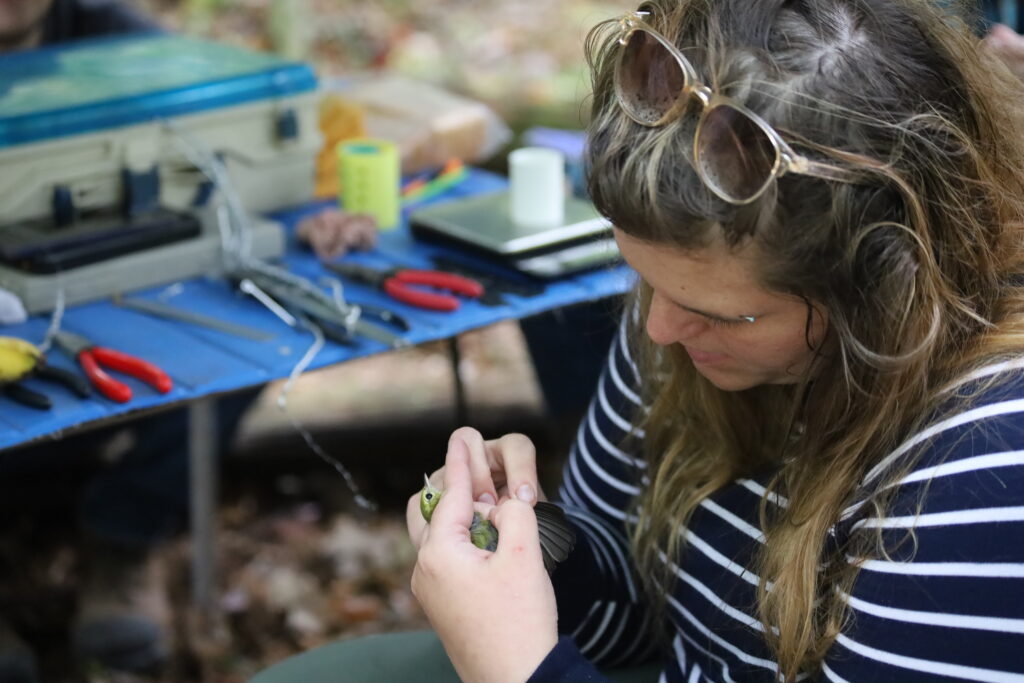
The Forest Gap Project is testing a model of sustainable forest management that uses multiple entries into the forest for very light timber harvests. We hypothesize that creating small, 1–5-acre canopy gaps through group selection cuts will provide habitat opportunities for important early-successional species, as well as habitat for dispersing fledglings of mature forest species. This allows the forest manager to mimic natural forest conditions and create, over time, structurally complex forests that will benefit a wide range of birds. If successful, this approach will have the added benefit of restoring forests to an uneven-aged condition that is beneficial to many more species that require structurally diverse forests. This forest management also supports landowners with small forest plots and the economic viability of rural communities through the restoration of working forests.
From 2021-2024, the National Aviary and Duquesne University worked with the Foundation for Sustainable Forests (FSF) in Crawford, Warren, and Erie counties, Pennsylvania, to test the efficacy of this sustainable forest management system that challenges the prevailing practices of even-aged forestry.
Initial results indicate that early successional species do find these small gaps and do nest in them. These early successional species remain as fledglings and as molting adults. Similarly, bird species that nest in the forest interior move into the gaps after fledging and remain through the molting period.
We are also asking the question, what key resources are birds using in the gaps? Fruit, which is largely unavailable in the mature forest understory, may be one key resource. However, the density of broadleaf plants in the gaps may also host many caterpillars, other insects, and arthropods that are a rich source of food. Birds may also switch diets, for example, from insects to fruit, depending upon physiological needs, especially as migration nears.
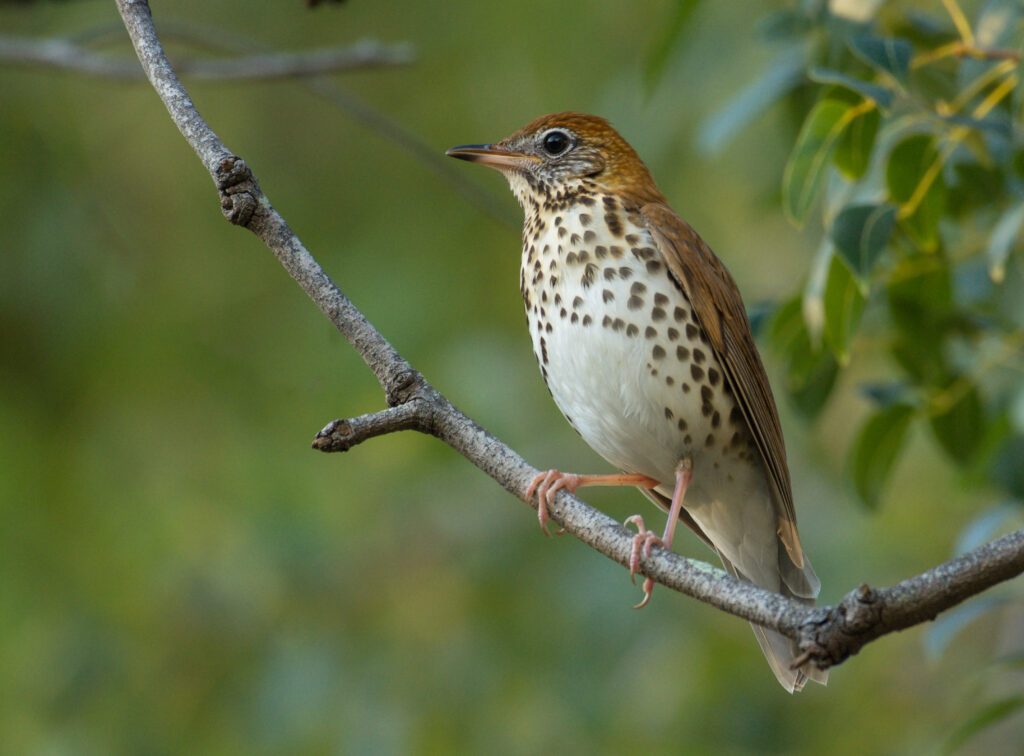
Doctoral candidate Cassie Ziegler from Duquesne University is addressing this question through DNA fingerprinting techniques. To identify what the birds are eating in the gaps, we have collected approximately 1,700 fecal samples from forty-one species to better understand the diets of birds in the gaps. Priority in analyses will be given to two focal species as examples of the ecology and behavior of birds in our two focal habitats: 1) the Wood Thrush, a bird that nests in the forest interior but that moves into the gaps following breeding, and is a species of conservation concern; and 2) the Grey Catbird, a declining, early-successional species that nests in the gaps and remains in this habitat until migration.
We have also collected blood samples from target species in order to use ratios of stable isotopes to better understand the relative amounts of each food item in the diet. Diets will be analyzed across species, gap size, gap age, and time to better understand how the use of the gaps changes, and to better inform management options to improve bird habitat.
A Surprising Discovery
Students from Bowling Green State University (BGSU), who are affiliated with the National Aviary’s Forest Gap Project, were lucky enough to catch an Eastern Towhee (an early successional species) with a fascinating, rare genetic anomaly! Lead Bird Bander, Nancy Ransom, set about banding an Eastern Towhee in September 2024 and knew immediately by its appearance that THIS bird was outside of the usual variation range that we might see while banding the species. In fact, this little bird has the external appearance of BOTH a male and a female: also known as a bilateral (side-to-side) gynandromorph. In this instance, the Eastern Towhee’s right side appeared male-like (black feathers); the left side was female-like (brown feathers). This uniqueness is easier to determine in species where males and females are known for different plumage hues.
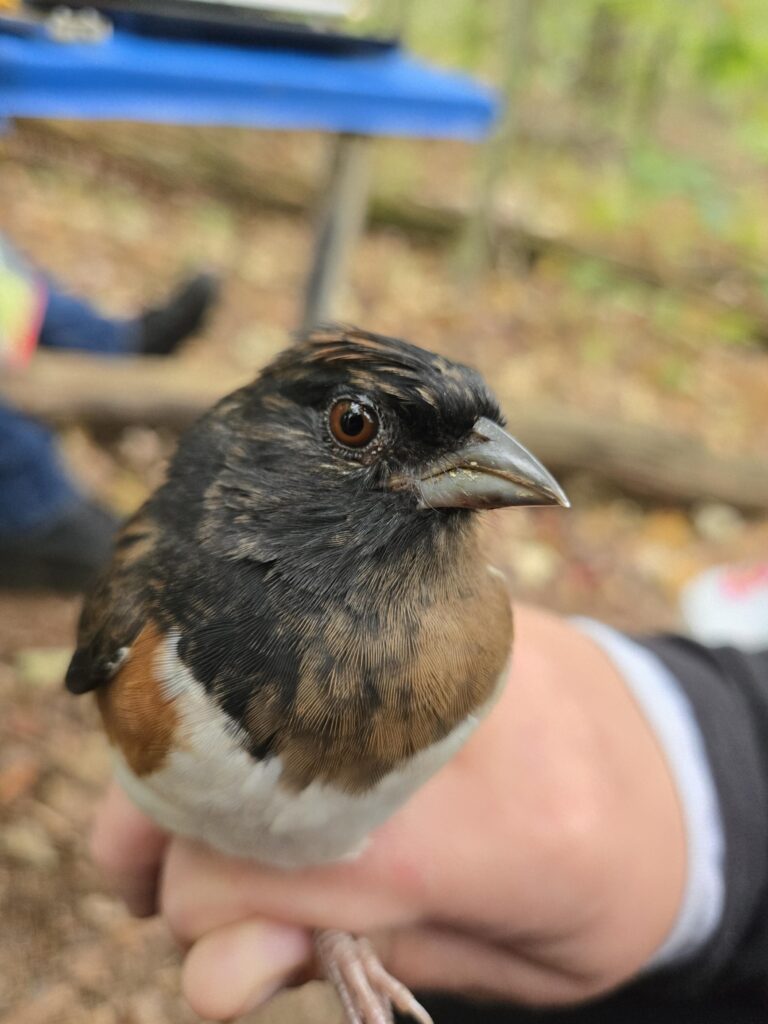
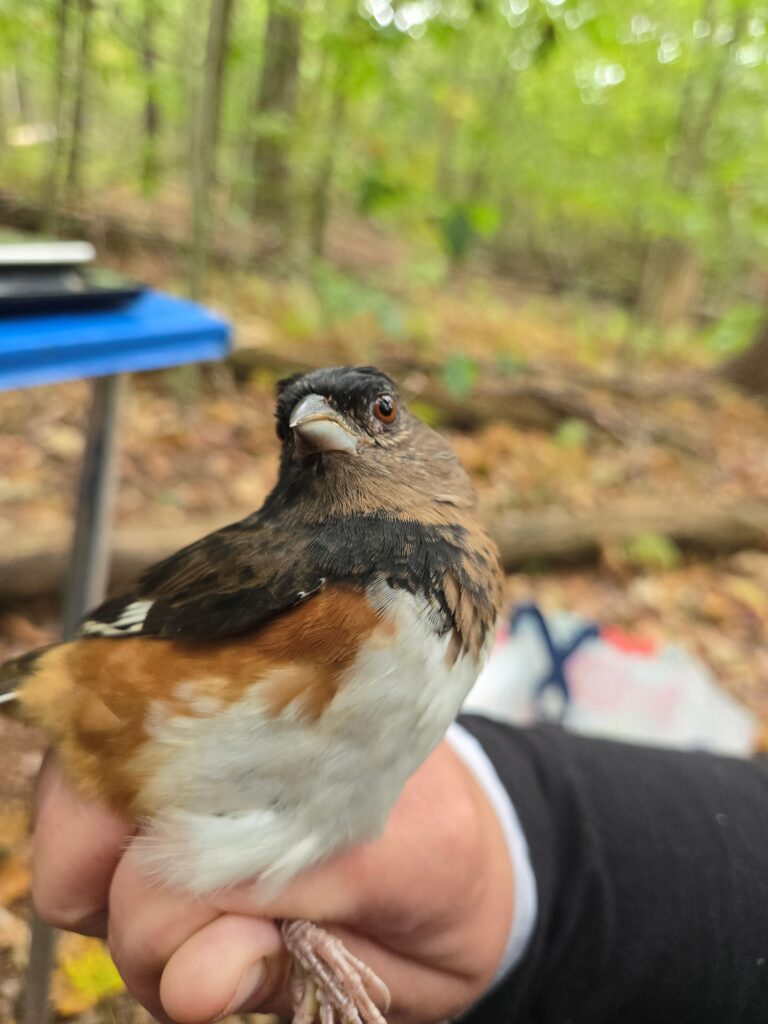
As an example of how rare an experience it is to band a gynandromorph, National Aviary Ornithologist Bob Mulvihill has seen just three in Southwestern Pennsylvania over more than 40 years of research, examining more than 250,000 birds!
“Only when we are privileged to be able to study a large number of birds, such as when we are conducting a bird banding study, do we have an increased chance of encountering an unusual variant,” said Mulvihill. “We recognize them as being unusual because we have already handled so many individuals of the species that we can quantify the extent of the normal variation in color or pattern in that species.”
After banding and photographs, the bird was safely released back into its forest habitat! Stay tuned for more project discoveries.