Meet Tasi, a tiny bird with a bubbly personality. Tasi is a Saipan White-eye, also known as a Bridled White-eye, a Critically Endangered species native to the Northern Mariana Islands. This species is threatened by the encroaching presence of an invasive snake–the same invasive snake species that ravaged the populations of Guam’s native birds, including the Guam Rail. Each bird at the National Aviary is special, and for a species like the Saipan White-eye, the future depends on only a few thousand individual birds, making the care of these precious birds all the more important.
When his caregivers noticed that Tasi, usually a dynamic and energetic bird, had nesting material entwined around his leg, they acted quickly. Tasi was brought to the National Aviary’s Avian Hospital where he was evaluated by the National Aviary’s expert team. They determined that this tiny bird would need surgery to remove the fibers wound around his leg.
Nesting is an innate activity, and many birds build delicate nests of thin, fine fibers like grasses and webbing. In the act of building their nest, it is common for birds to find themselves entwined in their nesting material. It can happen quickly, as it did for Tasi, and the results can be devastating: birds may become trapped in the nest, or worse, they may lose a leg.
Thankfully, Tasi received prompt care from a dedicated team to help him begin his journey to healing. Tasi is an incredibly tiny bird. Weighing only eight grams, his body is about the size of a grape and his head is the size of a blueberry. Caring for a bird this small requires delicate procedures using special tools.
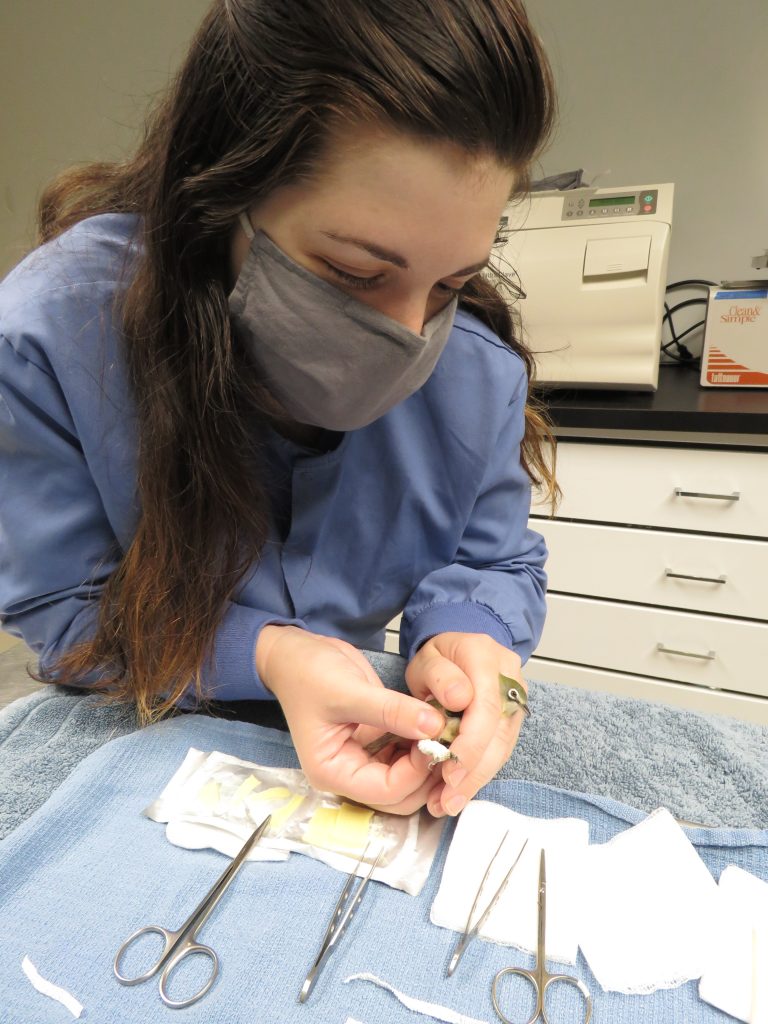
Tasi was treated during a two-hour surgery, wherein the National Aviary’s Veterinary Team used microsurgical tools–the same kind used for delicate surgeries on the human eye–to carefully remove the fibers. He was treated with human grade medications to promote healing, and was outfitted with a tiny cast. Creating the cast by building layer upon layer of bandaging was a painstaking task, and one that the veterinary team repeated weekly for six weeks so Tasi could receive topical medications.
The cast did nothing to slow down this spirited bird! Tasi was a model patient during his time in the Avian Hospital. He sweetly sang to the Veterinary Team and to his fellow patients as he recovered. With physical therapy to help him regain strength, Tasi was soon back to his usual energetic self, with full use of his leg.
Your support helps the National Aviary continue its work to provide outstanding care to birds like Tasi.
Give Today!