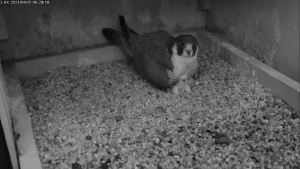
 A Peregrine Falcon egg has hatched at the University of Pittsburgh’s Cathedral of Learning nesting site in Oakland. The public can view the chick, which hatched early April 25 at around 3:09 a.m., and watch the progress of the hatchings of the three eggs remaining in the nest, via the National Aviary’s Nestcam at aviary.org/live-streams.
Parents Morela and Ecco have four eggs in their clutch at the nesting site high up on the Cathedral of Learning. Morela laid her first egg there on March 18, and she laid three more eggs on March 19, March 22, and March 24. Peregrine Falcons begin incubating the clutch after the second-to-last egg is laid. Incubation ordinarily lasts about 32 days.
“For the next few weeks, viewers of the National Aviary’s Nestcam are able to look up close at the world of wild Peregrine Falcons raising their first chicks,” says National Aviary Ornithologist, Bob Mulvihill. “The Nestcam offers a remarkable opportunity to view each step of their nesting cycle and to observe the behaviors of a Peregrine Falcon pair and their growing young. Viewers can watch as Morela and Ecco bring food to the nest and feed their chicks, observe the chicks’ growth and development, and follow them hour-by-hour and day-by-day on their remarkable journey to fledging.”
Peregrine Falcons are well known for nesting on man-made structures, including buildings and bridges, but their historical nesting aeries were on rock ledges and natural cliff sites. There are currently nine nesting pairs in the Pittsburgh region. The Cathedral of Learning at the University of Pittsburgh has been home to a pair of nesting Peregrines since 2001.
Peregrine Falcons were listed as an Endangered species in Pennsylvania until 2019. Their populations plummeted in the mid-twentieth century due to the widespread use of the pesticide DDT. The conservation status of Peregrine Falcons recently was upgraded to “Threatened” in Pennsylvania, after a steadily growing population in the state led to pairs re-occupying several historically occupied natural cliff-nesting sites in the northeastern part of the state.