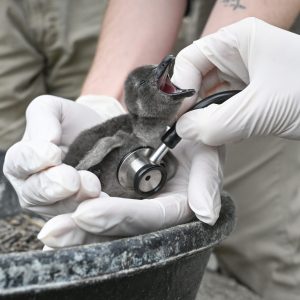
An endangered African Penguin has hatched at the National Aviary, marking a hopeful moment for a species that is experiencing continuing population declines in the wild. The National Aviary is a leader in African Penguin conservation, and this adorable chick is part of an important Species Survival Plan®. Saturday, October 8 marks International African Penguin Awareness Day, a day drawing attention to the conservation challenges facing African Penguins.
The chick was about the size of a lime and weighed 77 grams when it hatched on September 28, and is growing quickly. By 3 months of age, African Penguins reach their adult size of about 18 inches tall and up to 10 pounds. African Penguins are monomorphic, meaning males and females are visually similar, so a DNA feather test is needed to determine the chick’s sex.
The chick is the biological offspring of first-time parents Patrick and her mate, Owen. Because of the critical importance of each and every hatching for this endangered species, the chick is being raised by Patrick and Owen’s colony mates, Sidney and Bette. Sidney and Bette have fledged 10 chicks at the National Aviary and readily stepped in as “adoptive” parents. They are doing a fantastic job feeding, brooding, and caring for the chick, and Patrick and Owen continue to thrive in Penguin Point.
“Every hatching matters for species like African Penguins, which are endangered and facing rapid population declines,” says Chris Gaus, Senior Aviculturist at the National Aviary. “Each hatching is unique and we are always working to ensure chicks and parents are set up to thrive. This is particularly important in the very early days of chickhood, when chicks are fragile and require a high level of care.”
The National Aviary participates in the Species Survival Plan® for African Penguins, a collaborative program among Association of Zoos and Aquariums-accredited zoos that enhances conservation efforts and ensures the entire population of this species remains stable and healthy for the long-term future.
“Sidney and Bette are dedicated penguin parents, and we’re confident they will take excellent care of this new chick. We are already observing feeding, brooding, and preening behaviors, and can see that the chick is growing and developing well in their care,” says Gaus.
The chick is in a specially designed artificial nest burrow in Penguin Point and is being tended to around the clock by Sidney and Bette. Guests may hear the chick vocalizing with its parents in the habitat. The habitat has naturalistic elements of the South African coast—like heated rocky beaches, temperature controlled pools for diving and swimming, and cozy nest burrows—that encourage the natural behaviors of these social, curious birds.
Nest burrows like those used by Sidney and Bette in Penguin Point have been deployed in South Africa and Namibia, where human disturbance at nesting sites has greatly affected penguins’ breeding success. Human-caused pressures including the overharvesting of fish and disasters like oil spills have caused rapid declines, and today just over 1% remains of the African Penguin population, which numbered in the millions a century ago, with only 10,400 pairs remaining in South Africa. The National Aviary is the leader of AZA SAFE: Saving Animals From Extinction for African Penguins and works with colleagues around the world to identify and address short-term and long-term challenges facing this endangered species.
The National Aviary will celebrate International African Penguin Awareness Day on Saturday, October 8 from 10 a.m. to 4 p.m. with on-site activities and programs included with admission. Tickets can be purchased in advance at aviary.org.