
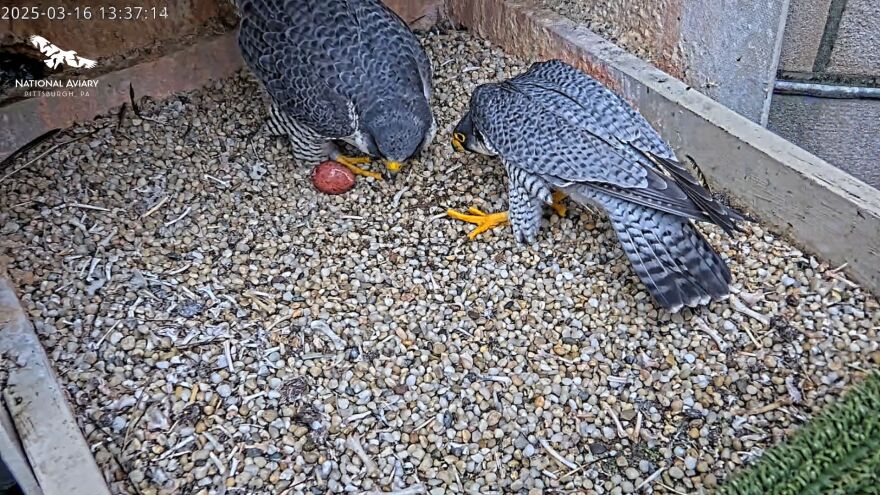
Dedicated — perhaps eagle-eyed — viewers of the National Aviary’s peregrine falcon camera may have spotted the pair’s first egg of the season over the weekend. Carla, a five-year-old female who has lived atop the University of Pittsburgh’s Cathedral of Learning since 2023, laid an egg shortly after 1:17 p.m. Sunday, according to the Aviary.
Livestream footage shows Carla and her mate Ecco examining the reddish-brown colored egg as they hop around the nesting box high up on the southeast side of the Cathedral of Learning in Oakland.
According to the Aviary, Carla is now expected to lay one egg every 48 hours until her clutch — the term for a group of eggs — is completed. A peregrine clutch can be three to six eggs, but the average number is four.
The Aviary said Monday to expect the eggs to remain uncovered in the nesting box until the next to last egg is laid. After that, Carla and Ecco will take turns incubating the eggs, with Carla handling most of the responsibility.
“Until then, it is perfectly safe for the eggs to be left uncovered as they have strong temperature tolerances — meaning they can endure the inconsistent climate changes brought by the Spring season,” the Aviary said in a release.
After Carla finishes laying her clutch of eggs, it’s expected to take a month before they hatch.
The egg comes after weeks of courtship activity, which includes beak-to-beak touching, synchronized head gestures, bowing and vocalizations. Peregrine males are also known to present food to their partners during courtship.
This year marks the second breeding season for the peregrine pair. Carla and Ecco laid four eggs in their nest in 2024, but only two chicks survived. It was the first year the couple occupied the nest together, after Carla replaced Ecco’s previous partner Morela, who disappeared in 2023.
Carla’s bands indicate that she was born in 2020 in Fort Wayne, Indiana. Ecco is unbanded, leaving his origin more of a mystery. But he first arrived at the Cathedral of Learning in 2021 when he ousted the previous resident male, Terzo.