Peregrine falcon pair on Pitt’s Cathedral of Learning lay first egg of season

Peregrine falcon pair on Pitt’s Cathedral of Learning lay first egg of season

The peregrine falcon pair in the nest on top of Pitt’s Cathedral of Learning have laid their first egg of the season.

The National Aviary says Carla laid an egg around 1:17 p.m. on Sunday. It’s the first of up to four that Carla and Ecco could lay this year, though sometimes there can be as many as six eggs in a peregrine falcon clutch.

Carla will now likely lay an egg every 48 hours until her clutch is complete. She won’t start incubating until all her eggs are laid, doing about two-thirds of the work while Ecco takes over the rest of the time. The aviary says it’s perfectly safe for the eggs to be left uncovered because they have strong temperature tolerances and can endure Pittsburgh’s rollercoaster springs. 
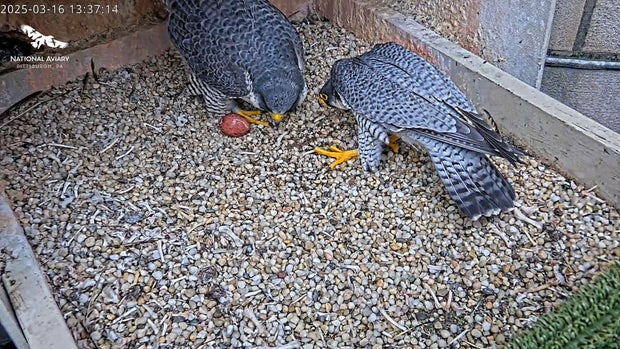
march-16-first-egg-laid-carla-left-and-ecco-on-camera-for-first-time-with-egg.jpg

Last season was Carla and Ecco’s first together, and there was plenty of excitement. While eggs usually hatch two to three days apart, two chicks hatched, fittingly, on Earth Day. They laid a total of four eggs, though one failed to hatch and the third chick died

Peregrine falcons used to be endangered in Pennsylvania because of the use of the pesticide DDT, but they were removed from the state’s threatened and endangered species list in 2021, the Game Commission says.   

Last year, the Game Commission placed lightweight bands with identifying numbers on the chicks’ legs, which will help scientists study the behavior of peregrine falcons while also keeping an eye on the status of their population. 

The aviary’s FalconCam livestreams the nest, which is high up on the southeast side of Pitt’s Cathedral of Learning. Viewers can watch Carla and Ecco’s family grow this year on the aviary’s website.

In The News

See All News

The Invisible Clues Animals Leave Behind Are Helping Save Entire Ecosystems (featuring an interview with Dr. Steve Latta) | A-Z Animals

In this article, we speak with Dr. Steven Latta, Director of Conservation and Field Research at The National Aviary. In his own work, he collects eDNA samples from water, leaf litter, feathers, egg shells, and other substrates to identify species presence.

Read More »

Why Animals in Cold Climates Are Bigger: The Science Behind Bergmann’s Rule (featuring an interview with Bob Mulvihill) | A-Z Animals

“Large animals can conserve heat more efficiently than smaller animals in cold climates,” explains Bob Mulvihill, Lead Ornithologist for the National Aviary.

Read More »

Penguins To Hold ‘Penguins Pledge Night’ Presented by U. S. Steel | Pittsburgh Penguins

The Penguins Pledge will also raise funds and call attention to the National Aviary in Pittsburgh and their conservation leadership with African Penguins.

Read More »

Record Number of Peregrine Falcons Counted in Allegheny County | National Today

Conservation efforts have helped the raptor species rebound in the region.

Read More »

Why Are There No Birds in My Birdhouse? I Asked Expert Bob Mulvihill Who Told Me How to Attract Birds to Any Birdhouse | Gardening Know How

To help ensure your birdhouses are as appealing to birds as possible, [we] asked a National Aviary Ornithologist Bob Mulvihill for the most common reasons why houses remain vacant and how to make houses more attractive to garden birds.

Read More »