National Aviary Peregrine FalconCam
Each spring and summer, the National Aviary hosts a live stream of the Peregrine Falcons residing high up on the southeast side of the Cathedral of Learning on the main campus of the University of Pittsburgh: The National Aviary Peregrine FalconCam.
So Long, 2026!
2026 was the most fruitful breeding season for Carla and Ecco to date, having hatched and fledged FOUR chicks for the first time since pair bonding in early 2023. The mates laid their most recent clutch in April, with the first three chicks hatching as the second and third rounds of the NFL Draft took place in Downtown Pittsburgh. The fourth hatched just days later to complete the Peregrine Falcon “Dream Team!”
Throughout their early stages, the four chicks spent most of their time in a snooze pile (very important for chick growth and development to get lots of rest!) and begging Mom and Dad for a nutritious meal (which they were happily provided with).
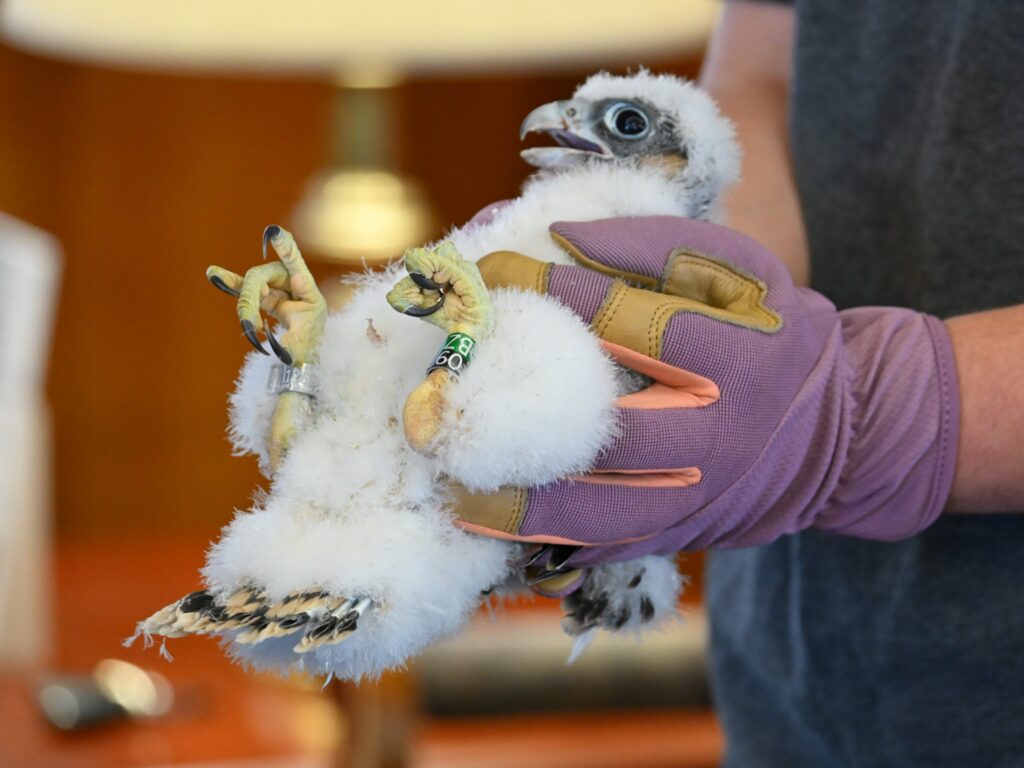
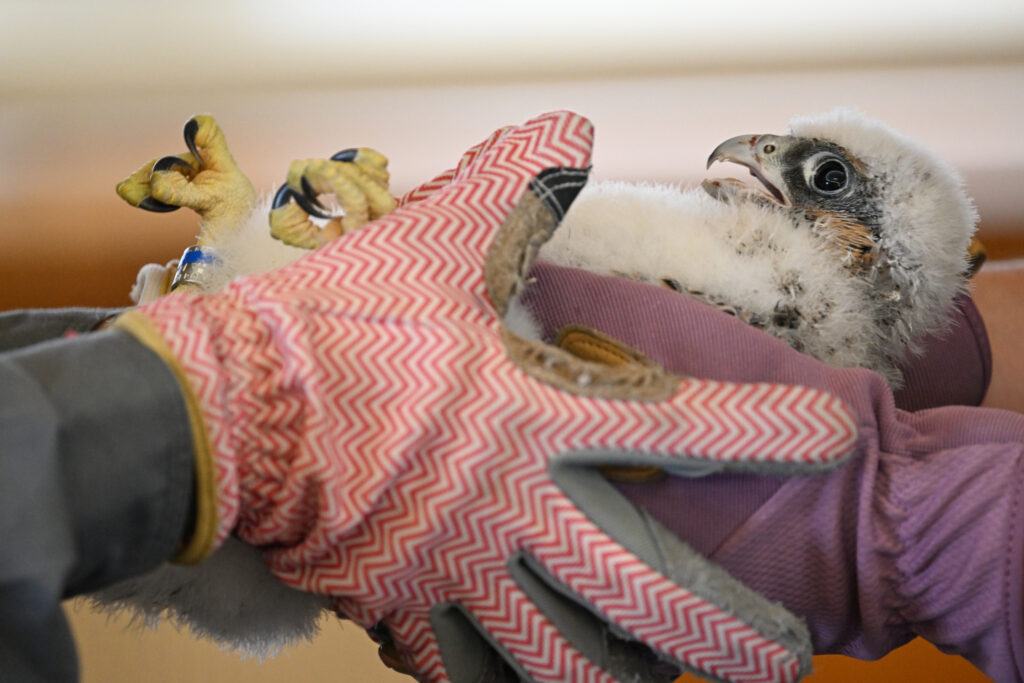
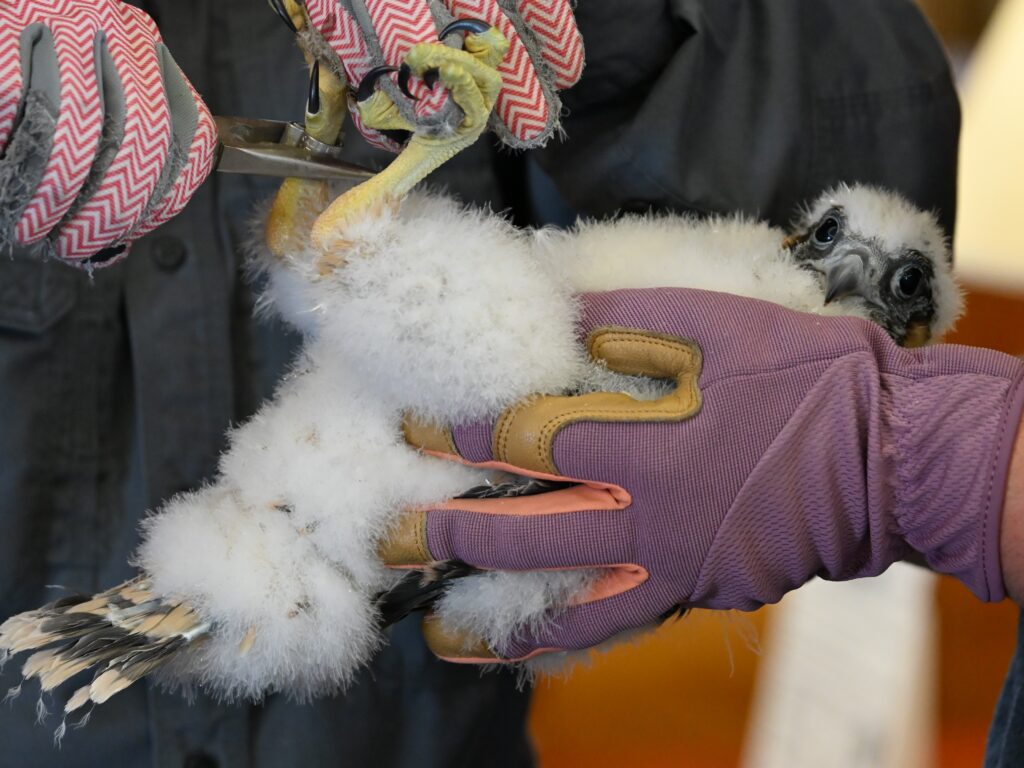
In late May, at around 30 days old, the Pennsylvania Game Commission (PGC)’s Environmental Species Specialist Patricia Barber arrived at the Cathedral of Learning to perform health exams and to band each juvenile. These exams included notations about their weight and leg thickness. These details help the PGC determine the sex of each individual; these numbers led Barber to suspect that at least two were female, one was male, and the fourth was too close to call!
These details were important to note for banding purposes. These unique identifying bands are an important way to keep track of where these falcons end up, to ensure the Peregrine Falcon population continues to be healthy and increasing. As female birds of prey are larger than males, it’s important to get the band sizing just right!
The juvenile with the unconfirmed sex was banded with a female-sized band as a result. Additionally, the PGC placed temporary, bird-safe colored tape atop the silver bands, so National Aviary Peregrine FalconCam viewers could identify the birds as they tuned in.
The colors this year were:
- Green (female)
- Yellow (female)
- Red (male)
- Blue* (sex undetermined; banded with female bands)
- *Not to be confused with Carla! She has a blue band on her right leg!
Not too long after banding, all four fledged the nest box. As they developed their abilities to hunt and fly longer distances, they all continued to hang around Oakland.
While staying in their parents’ territory after fledging is common…returning to the nest box isn’t! “Yellow” surprised even the most dedicated National Aviary Peregrine FalconCam viewers by returning to the nest box not once but TWICE after fledging, begging her parents for a “free meal.” The only known male from the clutch, dubbed “Red” for the colored tape on his Pennsylvania Game Commission-issued band, was found injured in Oakland shortly after leaving the nest. Despite extensive efforts at multiple licensed wildlife rehabilitation centers, Red sadly succumbed to his injuries. Learn more about his story below.
Later this year, the other young falcons will hopefully venture off to establish their own territories.
The National Aviary remains grateful to Ninja Transfers for their sponsorship of this year’s livestream, as well as the University of Pittsburgh and Aviary supporter Kate St. John for advocating for our feathered friends.
We look forward to the 2027 National Aviary Peregrine FalconCam season and are hopeful Carla and Ecco will return for another chapter.
2026 Peregrine FalconCam Nesting Updates
Friday, September 18: Wild Juvenile Peregrine Falcon “Red” Passes
Wildlife rehabilitation is important, allowing birds and other wildlife to recover from injury and illness and, if necessary, a place to learn skills needed to thrive once back in the wild. This work isn’t possible without constant coordination and collaboration amongst a network of animal care organizations, from licensed wildlife centers and veterinary hospitals to zoos; those who study or help train birds, and those who support the work to do so.
Unfortunately, despite collaborative efforts, a wild animal’s injuries and resulting health conditions may be too great to overcome. Such is the case with “Red,” the juvenile Peregrine Falcon.
The 2026 National Aviary Peregrine FalconCam livestream showed four chicks hatch and fledge under the care of wild pair Carla and Ecco atop the University of Pittsburgh’s Cathedral of Learning. The only known male from the clutch, dubbed “Red” for the colored tape on his Pennsylvania Game Commission-issued band, was found injured in Oakland shortly after leaving the nest. He was quickly admitted to Humane Animal Rescue of Pittsburgh’s Wildlife Rehabilitation Center (HARP) for treatment.
As his recovery was very slowly making gains, HARP transferred him to Tamarack Wildlife Center for further rehabilitative care, as Tamarack specializes in the treatment of birds of prey. There, his dedicated care team worked to understand and resolve several medical issues Red was still facing. They also worked to line up a licensed falconer specializing in Peregrines who could give him the life skills needed to eventually be released into the wild (such as hunting and flight practice).
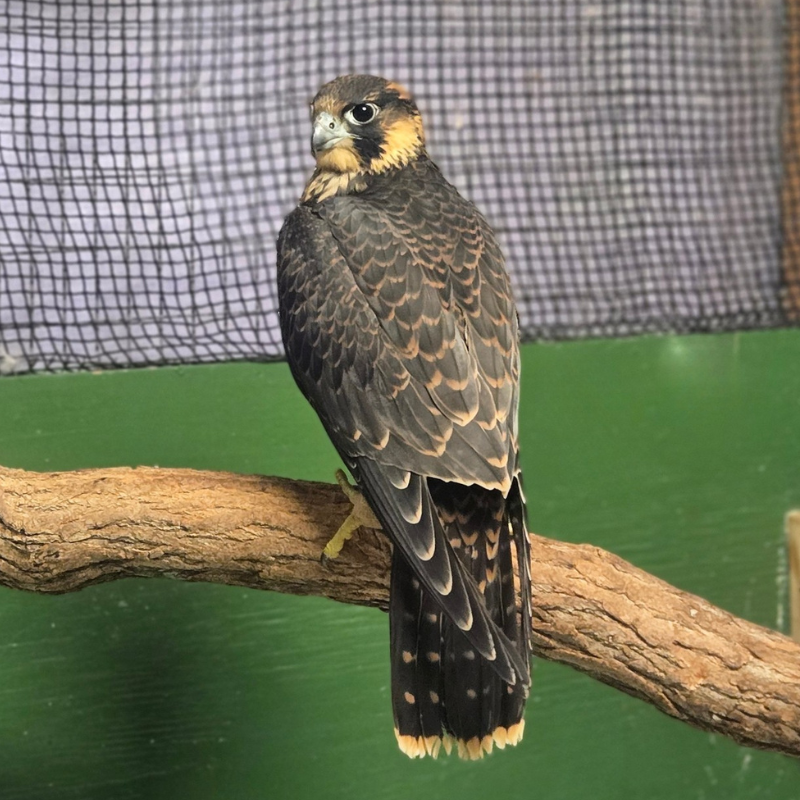
However, Red never became medically stable enough. With increasing concern about his medical issues, Tamarack obtained special state permissions to transfer him to Cornell University’s Janet L. Swanson Wildlife Hospital for advanced diagnostics and treatment. Supported by Cornell University’s College of Veterinary Medicine, this wildlife hospital provides state-of-the-art medical and surgical care for wildlife above and beyond what HARP or Tamarack can offer.
Although Red showed signs of initial signs of improvement, at the end of August his condition deteriorated suddenly in a matter of days, and sadly passed away. A necropsy performed by Cornell showed chronic severe respiratory issues that he likely would not ever have been able to survive, regardless of treatment.
Although Red could not be saved, our hearts are warmed by the many organizations and individuals who worked together to help him.
Red will live on in the hearts of many, especially from the following organizations and individuals:
- Kate St. John
- University of Pittsburgh
- National Aviary
- Humane Animal Rescue of Pittsburgh’s Wildlife Center
- Tamarack Wildlife Center
- Cornell University’s Swanson Wildlife Hospital
Thursday, July 9: Why Wildlife Rehabilitation Matters.
At the end of May, our friends at the Pennsylvania Game Commission (PGC) banded this year’s brood of chicks and added temporary, bird-safe colored tape (Green, Yellow, Red, and Blue) to their U.S. Fish and Wildlife Service bands so all of you watching on the National Aviary Peregrine FalconCam livestream could easily tell them apart. It didn’t take long before many of you got to know “Red” by his “band-color-inspired” moniker and wanted to follow his adventures through his fledgling.
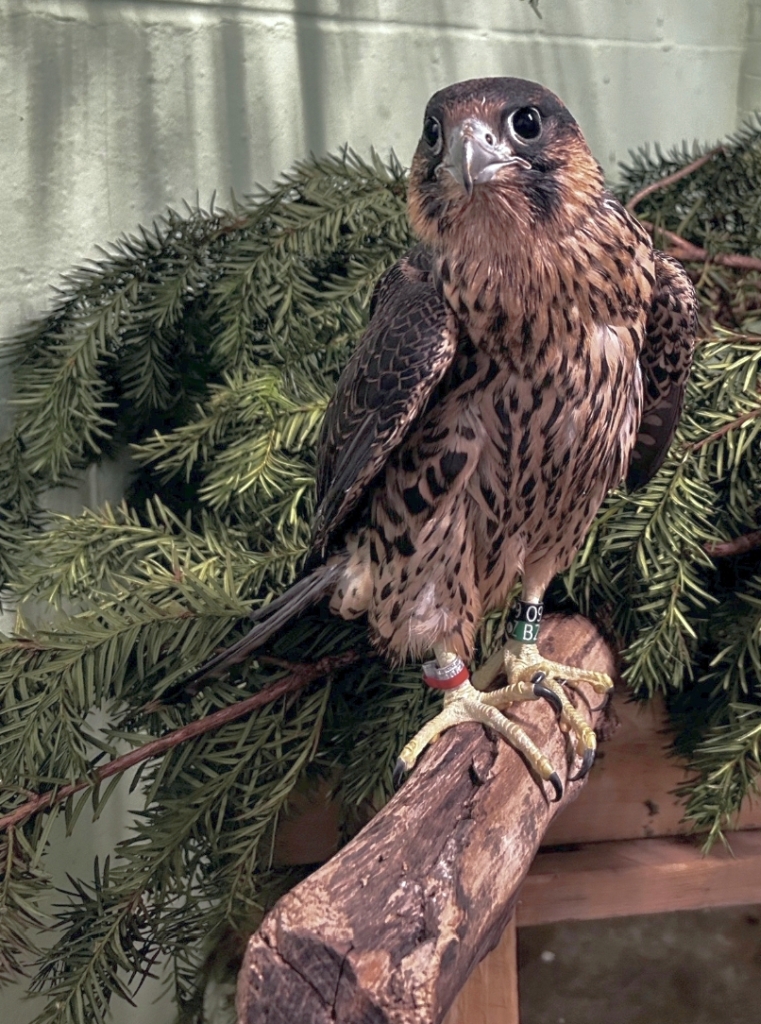
Unfortunately, not long after leaving the nest, Red was found in Oakland with a serious head injury after an apparent collision. He was quickly admitted to the Humane Animal Rescue of Pittsburgh’s Wildlife Center (HARP) for treatment. There, he was also diagnosed with elevated lead levels.
Thanks to the care of HARP’s licensed wildlife rehabilitators, Red received treatment for his injuries and lead exposure. While his wounds healed, he wasn’t yet able to fly with the strength and coordination needed to hunt and survive on his own. Rather than being released too soon, he was transferred to a specialized rehabilitation facility where he can continue building the skills he’ll need to thrive in the wild.
When asked about the importance of this type of treatment, National Aviary Manager of Veterinary Education and Patient Care, Jess Lindberg, said, “Wildlife rehabilitation gives animals a second chance while helping protect the biodiversity of our natural world. Every animal saved is a step toward a healthier ecosystem.”
Red’s story is a powerful reminder of why wildlife rehabilitation is so important. Recovery isn’t just about healing injuries; it’s about ensuring wild animals regain the strength, coordination, and survival skills they need before they’re released. That careful process gives animals like Red the best possible chance of living successful lives back in the wild.
We know so many of you have been invested in Red’s journey since banding, and we’re grateful he received the expert care he needed. While we love sharing these incredible birds and educating about their lives, the National Aviary is not a licensed wildlife rehabilitation center. If you ever find an injured or orphaned wild animal, please get in touch with a licensed wildlife rehabilitator.
As for Red’s other siblings? While we haven’t seen much of Blue and Green since their fledging, Yellow has made occasional appearances at the nest box – hoping to get one final “free meal” from Mom and Dad!
Thank you to HARP for diligently treating this young fledgling and Kate St. John of Outside My Window for helping to tell his story.
The National Aviary Peregrine FalconCam is generously sponsored by Nina Transfers. It’s important to remember that the Peregrine FalconCam gives us a view into the wild world of birds, and while it’s not our role to intervene, we can learn a lot by studying these behaviors.
Friday, June 12: An ever-growing family tree! While we don’t know much about Ecco’s beginnings, thanks to Carla’s bands, we can trace her ancestry rather easily!
Carla hatched in 2020 (ironically on another live stream!) alongside three brothers, who were dubbed Bolt, Unity, and Artemis. Carla’s bloodline is extraordinary, with Moxie (mom) and Jamie (dad), who have raised more than 30 chicks atop the IMPC building in Michigan since 2013. Fans who followed the nest cam watched Carla grow from a fluffy hatchling to a powerful young falcon, learning to hunt under the guidance of her devoted parents.
In a fitting twist of fate, Carla returned to the spotlight when she first appeared on the National Aviary Peregrine FalconCam in 2023. Viewers can see echoes (or shall we say “Eccos” wink wink) of Moxie’s vigilance and Jamie’s steady dedication in the way Carla cares for her own young. Over the years, Carla has successfully fledged nine chicks of her own, continuing the remarkable family legacy that first captured hearts back in 2020. Her most recent brood of chicks fledged as of June 7, 2026!
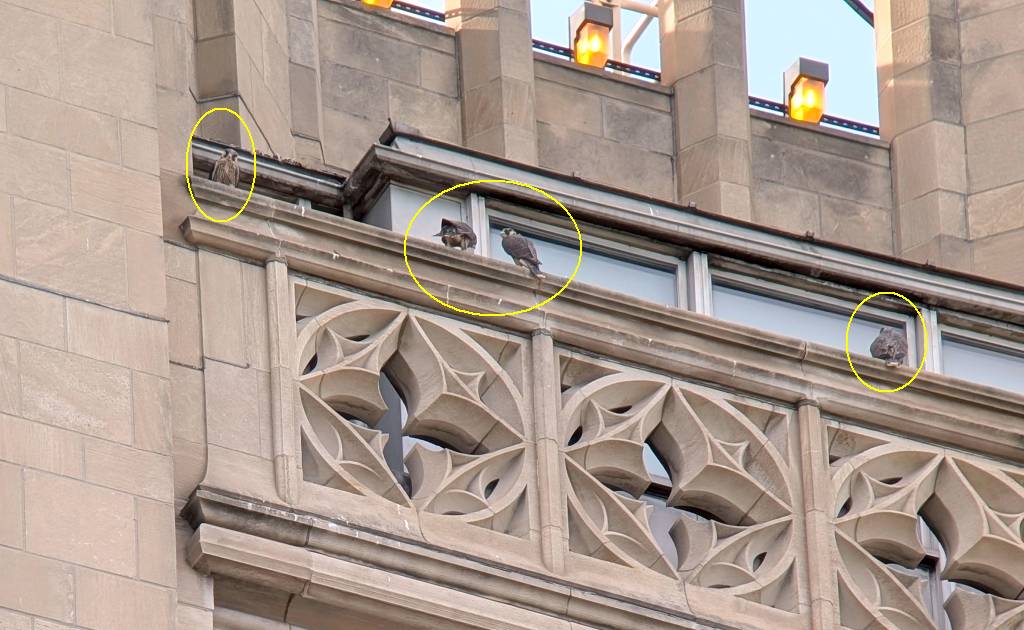
Wednesday, June 3: Queue Movin’ Out by Billy Joel, Carla and Ecco’s four chicks officially fledged the nest as of June 2! Before their first official venture out of the nest box, each of the birds took turns alongside the edge of the nest box (or nestrail), stretching and flapping (exercising) their wings, preparing themselves for their big “leap!”
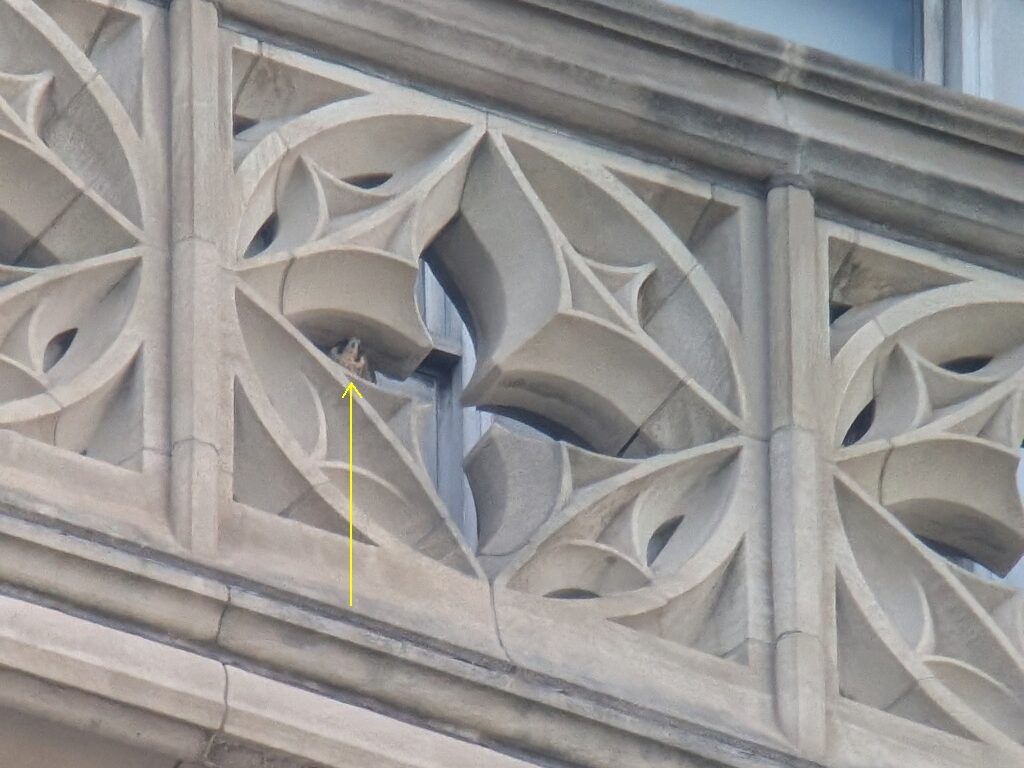
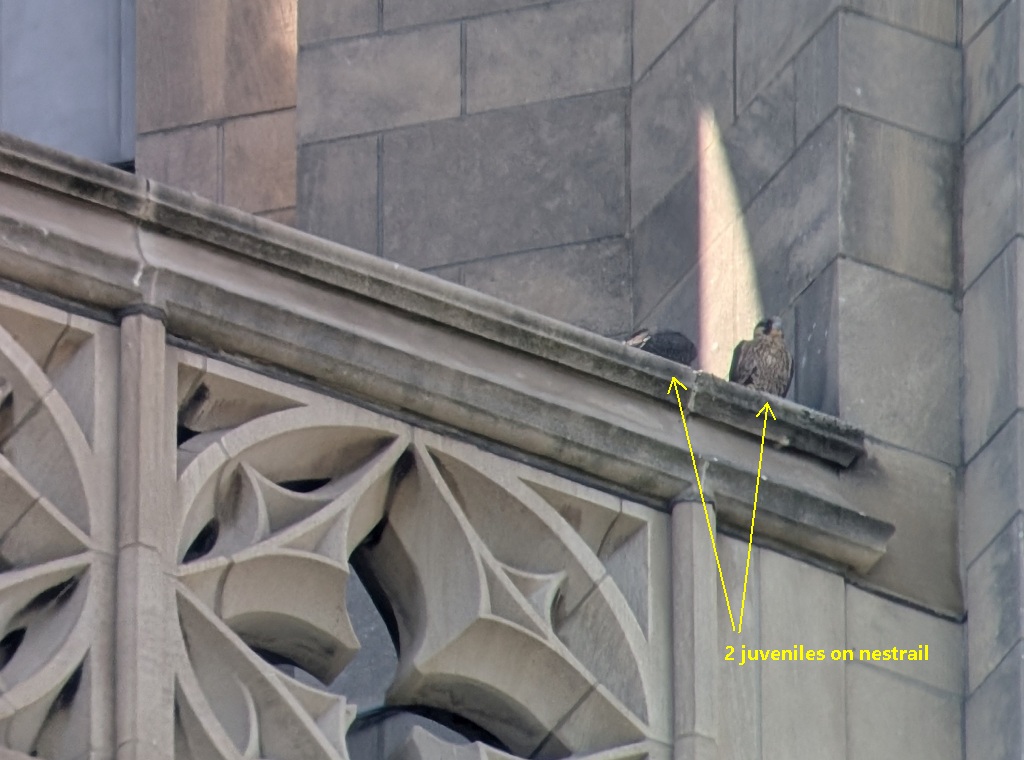
They aren’t officially “Movin’ Out” just yet; they will remain in their parents’ territories for a few more weeks to master the art of flying and hunting before heading out on their own adventure! We will be able to track their next moves thanks to their recent banding by a biologist from the Pennsylvania Game Commission, with support from the University of Pittsburgh and the National Aviary. Whether they remain local or move to another bridge, cliff, or skyscraper rooftop in Pennsylvania or another nearby state, we should be able to tell where they end up, when they mate, and if they are surviving and thriving in their new homes.
Although viewers may no longer see Carla and Ecco’s four juveniles on the National Aviary Peregrine FalconCam, our stream will remain live through the end of July. During this time, Carla and Ecco will likely be seen popping in and out of their nest box.
The National Aviary remains grateful to Ninja Transfers for their National Aviary Peregrine FalconCam sponsorship, the University of Pittsburgh, Aviary friend and supporter Kate St. John, the PGC, and all our dedicated viewers.
It’s important to remember that the Peregrine FalconCam gives us a view into the wild world of birds, and while it’s not our role to intervene, we can learn a lot by studying these behaviors.
Tuesday, May 26: We’re one week post-banding! ICYMI: The Pennsylvania Game Commission(PGC) banded three of Carla and Ecco’s chicks last week; learn more below. The PGC placed bird-safe colored tape on the silver U.S. Fish and Wildlife Service bands so National Aviary Peregrine FalconCam viewers can identify the birds while tuning in!
- Green (female)
- Yellow (female)
- Red (male)
- Blue (sex undetermined; banded with female bands)
- Not to be confused with Carla! She has a blue band on her right leg!
All four chicks are “growing like weeds” and are changing every single day. Their plumage is more “speckled” as their flight feathers continue to replace their downy feathers, and they beg for food loudly (after all, the more they eat, the stronger they become)! Even with their continued development, they have not left the nestbox just yet – that’s expected to happen in early June!
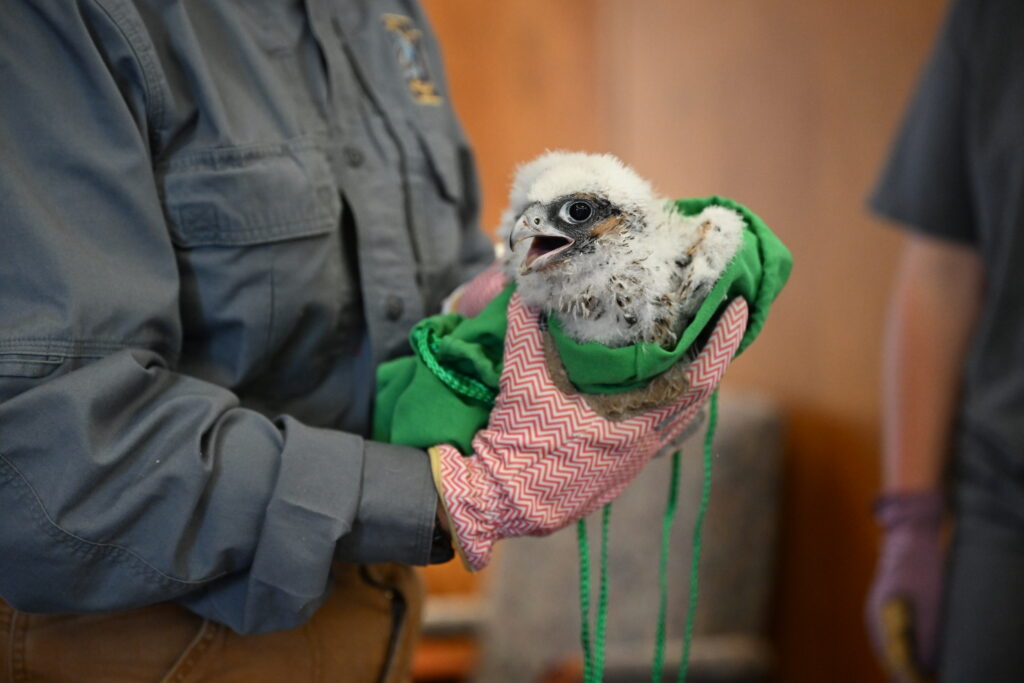
Wednesday, May 20: Third time’s a charm! This morning marked the THIRD year in a row that Carla and Ecco’s chicks were banded by the Pennsylvania Game Commission (PGC) at the University of Pittsburgh’s Cathedral of Learning.
2026 was an egg-citing year on the National Aviary Peregrine FalconCam as the wild Peregrine Falcon tackled raising FOUR chicks for the very first time since the beginning of their pair bond. As the first three chicks broke through their shells one by one, the NFL Draft unfolded in a similar way – full of expecting prospects and new beginnings! The fourth arrived just a few days after the Draft concluded.
All four chicks have grown under the watchful eyes of Mom, Dad, and Peregrine FalconCam viewers! As we closely monitored the camera, we coordinated with the PGC to determine an ideal banding date for the young brood, which, for Peregrine Falcon chicks, is between 22 and 30 days old. At this age, they are large enough to wear adult-sized bands but lack flight feathers , which prevents premature fledging when approached by PGC biologists.
According to PGC Endangered Bird Biologist, Patricia Barber, who has banded Carla and Ecco’s past two broods, the longevity of the nesting site atop the Cathedral of Learning offers big returns in how we understand a bird species’ life cycle.
“The Cathedral of Learning is one where we have been tracking birds for decades, since DDT recovery, and the fact that we have that long-term data collected is so important, says Patricia. “You can’t truly understand how a species ages, their reproduction, and the growth of the population, unless you have that information tracked. Banding in the nest allows us to plan ahead for when the juveniles come back as breeders, and it’s setting them up for success so that they are successful!”
After performing a health exam, including measuring leg thickness and overall weight, Patricia suspects that there are two confirmed females, one confirmed male, and one who is either a large male or a small female. In most birds of prey, including Peregrine Falcons, females are larger than males; therefore, weight and leg thickness are useful factors in attempting to determine the sex. Leg thickness also informs Patricia’s choice of the appropriate band size for each bird, as the lightweight band must fit comfortably. The juvenile with an unconfirmed sex was banded with a female-sized band as a result, ensuring that the band stays on properly for avian conservationists to keep a record of the bird.
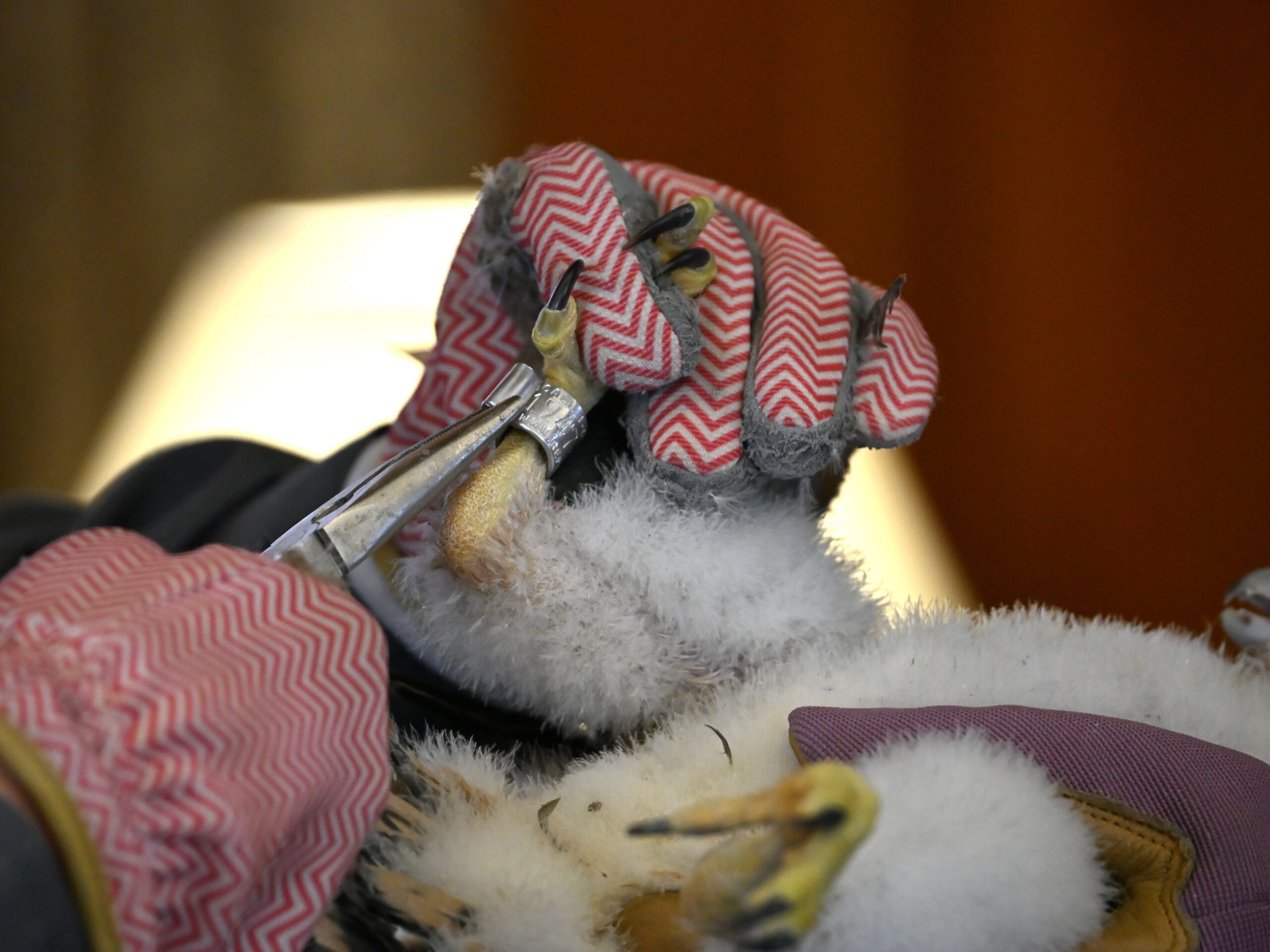
“As someone who has dedicated their life to saving birds and protecting their habitats, having direct access to certain species like the Peregrine Falcon and their movements is so important to the work we do,” says National Aviary Ornithologist Bob Mulvihill. We (at the National Aviary) are incredibly thankful to the PGC and their team for agreeing to band Carla and Ecco’s offspring these past three years. The data collected from the bands – now worn by a total of nine chicks raised by this Falcon pair – is beyond helpful to our plight of keeping these remarkable raptors thriving in the wild.”
The banding of any Peregrine Falcon chick (in this case, four) is a vital component of their ongoing conservation. Peregrine Falcons faced extinction in the United States, with an all-time low of 324 nesting pairs remaining in North America in the mid-1970s. The widespread use of harmful pesticides, including DDT, led to thin-shelled eggs that often broke during incubation. A complete ban on DDT and coordinated conservation efforts have allowed this species to rebound, with more than 3,000 known breeding pairs across Canada, Mexico, and the U.S.
Carla and Ecco’s four chicks are expected to fledge in late May or Early June!
The National Aviary remains grateful to Ninja Transfers for their National Aviary Peregrine FalconCam sponsorship, the University of Pittsburgh, Aviary friend and supporter Kate St. John, the PGC, and all our dedicated viewers.
It’s important to remember that the Peregrine FalconCam gives us a view into the wild world of birds, and while it’s not our role to intervene, we can learn a lot by studying these behaviors.
Tuesday, May 12: Friday, May 15 is Endangered Species Day. The U.S. Fish and Wildlife Service removed the Peregrine Falcon from the Endangered and Threatened Species List in 1999, marking the culmination of a decades-long conservation effort to protect the world’s fastest animal.
In the mid-20th century, Peregrine Falcons experienced a sharp population decline due to the widespread use of pesticides, like DDT, leading to thin-shelled eggs that broke during incubation. The detrimental effect on wildlife was further highlighted by Pittsburgh native Rachel Carson’s publication, Silent Spring, in 1962. In 1972, DDT was banned in the United States, marking the first step in Peregrine Falcon population recovery. Although this was a critical step, by the mid-1970’s, Peregrine Falcons continued to dwindle to an all-time low of 324 nesting pairs in North America.
Although no longer listed as Endangered, Peregrine Falcons still receive protection under the Migratory Bird Treaty Act, which prohibits poaching, possession, and transportation of migratory birds without the prior approval of government officials. Peeking into the wild world of Peregrine Falcons via the National Aviary Peregrine FalconCam lets us observe these raptors’ instincts up close, ensuring that conservation efforts continue to meet the needs of their species.
As Carla and Ecco continue to raise their third brood, they are simultaneously teaching us the importance of protecting their species future, which helps to support the biodiversity of our shared planet for generations to come.
The National Aviary Peregrine FalconCam is generously sponsored by Nina Transfers. It’s important to remember that the Peregrine FalconCam gives us a view into the wild world of birds, and while it’s not our role to intervene, we can learn a lot by studying these behaviors.
Tuesday, May 5: At more than one week old, Carla and Ecco’s four chicks have now doubled their weight! National Aviary Ornithologist Bob Mulvihill noted that from now until about 20 days of age, the adults will spend between 3 – 9% of their time feeding the chicks, with a “feeding rate” of about one meal every 43 to 75 minutes. To keep up with the rate of consumption, Ecco will do most of the hunting. He will occasionally feed the chicks; however, most of the time, Carla will take the meal from Ecco and distribute it to her chicks accordingly.
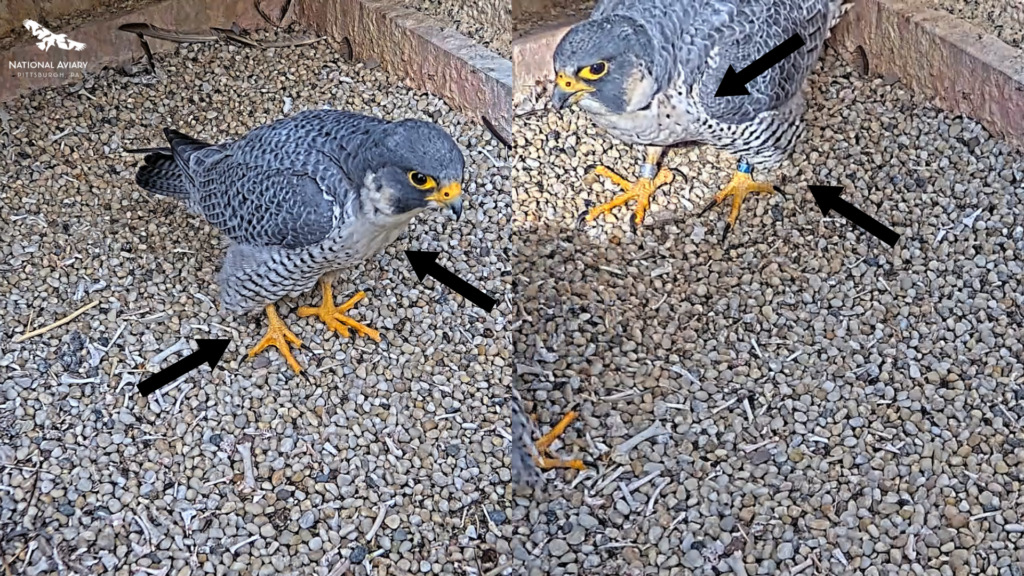
As National Aviary Peregrine FalconCam viewers continue to watch this family of six grow and develop, there’s a simple trick for identifying each of the adults! Unlike Ecco, Carla is banded! She was banded (Black/Blue S/07) in 2020 at One Summit Square in Fort Wayne, Indiana. If you don’t have a clear view of the ankles, take a look at the chest plumage. Carla’s chest has specks of dark feathers, while Ecco’s is completely white.
The National Aviary Peregrine FalconCam is generously sponsored by Nina Transfers. It’s important to remember that the Peregrine FalconCam gives us a view into the wild world of birds, and while it’s not our role to intervene, we can learn a lot by studying these behaviors.
Monday, April 27: And with the FOURTH HATCH of the National Aviary Peregrine FalconCam season…Carla and Ecco’s fourth and final egg hatched around 1:05 pm EST.
Peregrine Falcons fledge the nest roughly 40 days after hatching. After they fledge, the young will remain with their parents for a portion of the summer, paying close attention to how they hunt. Once they have mastered that all-important skill, they will leave to establish their own territory!
This is Carla’s first attempt at being a mother to FOUR. Tune in to watch this dynamic unfold.
The National Aviary Peregrine FalconCam is generously sponsored by Nina Transfers. It’s important to remember that the Peregrine FalconCam gives us a view into the wild world of birds, and while it’s not our role to intervene, we can learn a lot by studying these behaviors.
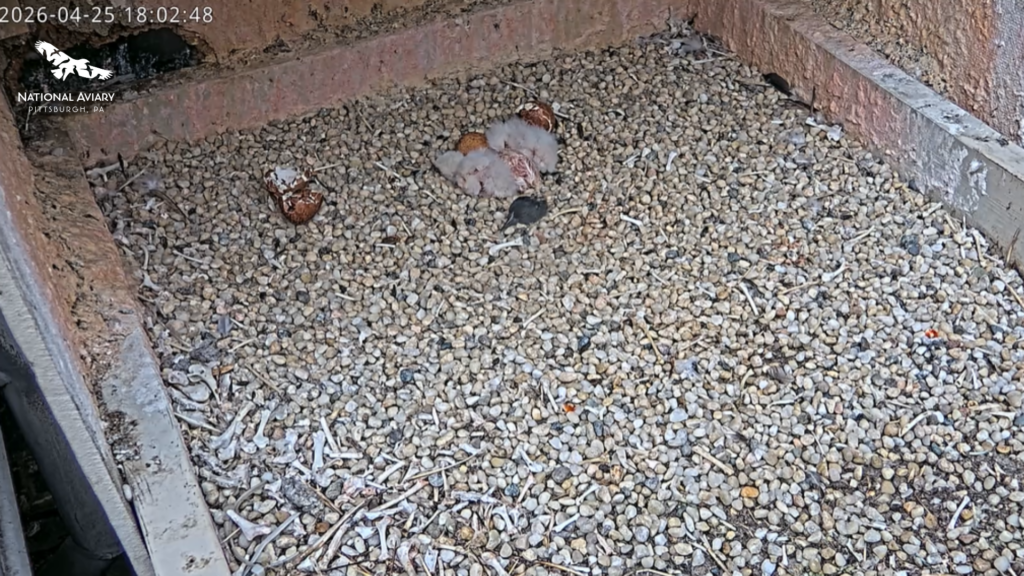
Saturday, April 25 PART TWO: Carla and Ecco’s Dream Team just added another tiny set of wings! Their THIRD CHICK broke through its shell roughly three hours after the second hatchling, making its official National Aviary Peregrine FalconCam debut on Sat., April 25, around 6 pm EST.
With three tiny mouths to feed, both parents will be caring around the clock, showcasing the incredible dynamic between two of the fastest birds on the planet. An example of their efforts is the leftovers from earlier meals scattered throughout the nest box.
The National Aviary Peregrine FalconCam is generously sponsored by Ninja Transfers. It’s important to remember that the Peregrine FalconCam gives us a view into the wild world of birds, and while it’s not our role to intervene, we can learn a lot by studying these behaviors.
Saturday, April 25: Carla and Ecco’s second-string player (aka chick!) hatched around 3:15 pm EST. If Carla and Ecco can source plenty of food, this second chick will grow quickly (just like the older sibling!) and may even close the size and strength gap within a couple of weeks!
Check out a clip of this second chick’s first meal alongside its sibling here.
Tune into this ever-growing family on the National Aviary Peregrine FalconCam, generously sponsored by Ninja Transfers.
It’s important to remember that the Peregrine FalconCam gives us a view into the wild world of birds, and while it’s not our role to intervene, we can learn a lot by studying these behaviors.
Friday, April 24: 2026 first round pick 🤝 2026 first Peregrine FalconCam hatchling. Carla and Ecco’s FIRST chick hatched around 11:03 pm EST!
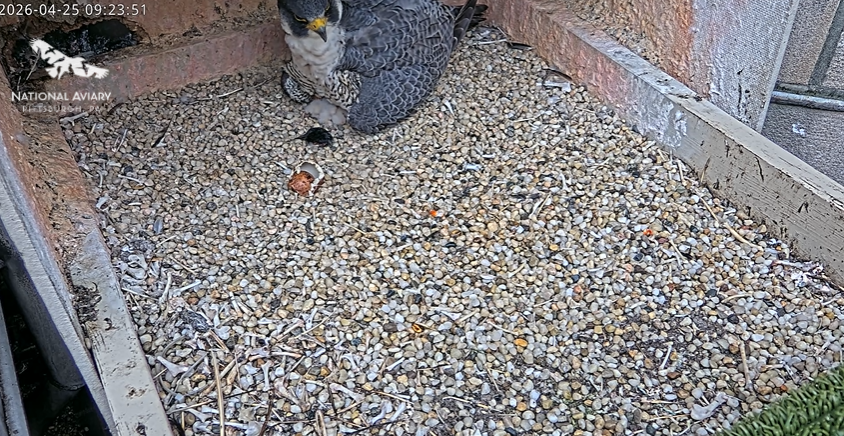
If fertile, the remainder of Carla’s eggs will likely hatch within 24-48 hours, sometimes referred to as a “synchronous” hatching, as nearly all of them hatch on the same day.
Tune back in regularly to witness these Peregrine parents raise their NEW little one.
Thank you to the National Aviary Peregrine FalconCam sponsor, Ninja Transfers. It’s important to remember that the Peregrine FalconCam gives us a view into the wild world of birds, and while it’s not our role to intervene, we can learn a lot by studying these behaviors.
Thursday, April 9: As Carla and Ecco continue to take turns incubating their clutch, Aviary Ornithologist Bob Mulvihill has provided even more of an inside scoop on Peregrine Falcon nesting behaviors and incubation practices!
Peregrine Falcons not only nest on human structures (like the top of the Cathedral of Learning) but also occasionally on rocky cliff ledges and even on the ground! As dedicated livestream viewers may have noticed, peregrines do not generally add extra materials to their nest; they form a round “scrape” with their legs and body, and this defines the area that holds the eggs. Peregrine Falcon eggs have a shell that is not only thick and strong enough to not crack against the small gravel underneath them, but can also withstand the weight of the incubating adults.
As shown on the live stream, incubation is accomplished by direct contact of the eggs between Carla and Ecco’s skin through lateral brood patches, allowing them to keep their unhatched young safe and protected! Stay tuned as the first egg could hatch in just a few weeks!
Thank you to the National Aviary Peregrine FalconCam sponsor, Ninja Transfers. It’s important to remember that the Peregrine FalconCam gives us a view into the wild world of birds, and while it’s not our role to intervene, we can learn a lot by studying these behaviors.
Wednesday, March 25: And then there were FOUR! It’s no mystery that Carla laid her fourth egg in the early hours of Wed., March 25, at 1:20 am EST. Having begun the incubation process after laying her third egg on Sun., Carla diligently incubated her clutch until Ecco took over around 7 am EST (watch here!).
As dedicated National Aviary Peregrine FalconCam viewers may know, Peregrine Falcon clutches typically consist of four eggs, and their incubation period is 33-34 days. During this time, Ecco will bring Carla food and share incubation duties for one-third of the time.
Thank you to the National Aviary Peregrine FalconCam sponsor, Ninja Transfers. It’s important to remember that the Peregrine FalconCam gives us a view into the wild world of birds, and while it’s not our role to intervene, we can learn a lot by studying these behaviors.
Sunday, March 22: Third time’s a charm! In the midst of rainshowers, Carla laid her third egg at 4:45 pm EST. Peregrine Falcon incubation beings when the female has laid her next-to-last egg…will Carla begin incubation? Tune in to find out!
Thank you to the National Aviary Peregrine FalconCam sponsor, Ninja Transfers. It’s important to remember that the Peregrine FalconCam gives us a view into the wild world of birds, and while it’s not our role to intervene, we can learn a lot by studying these behaviors.
Friday, March 20: I spy with my little eyes…a SECOND EGG! Carla laid this egg at 12:02 pm EST. She tipped viewers off by looking up towards the camera, opening her mouth, and then stepping to the side to reveal another brown-speckled egg. Watch that moment here.
Thank you to the National Aviary Peregrine FalconCam sponsor, Ninja Transfers. It’s important to remember that the Peregrine FalconCam gives us a view into the wild world of birds, and while it’s not our role to intervene, we can learn a lot by studying these behaviors.
Wednesday, March 18: SWOOP there it is…the FIRST EGG of the National Aviary Peregrine FalconCam season has arrived!
This egg – laid in the early morning hours of Wed., March 18, around 4 am EST – is the first of up to six Carla may lay (although the average Peregrine Falcon clutch is four). She will likely lay one egg roughly every 48 hours until her clutch is completed. We’ll know when it is as she will begin incubating (or covering) her eggs after laying the second-to-last one. Carla will split the incubation duties with Ecco, who will take on the task roughly one-third of the time.
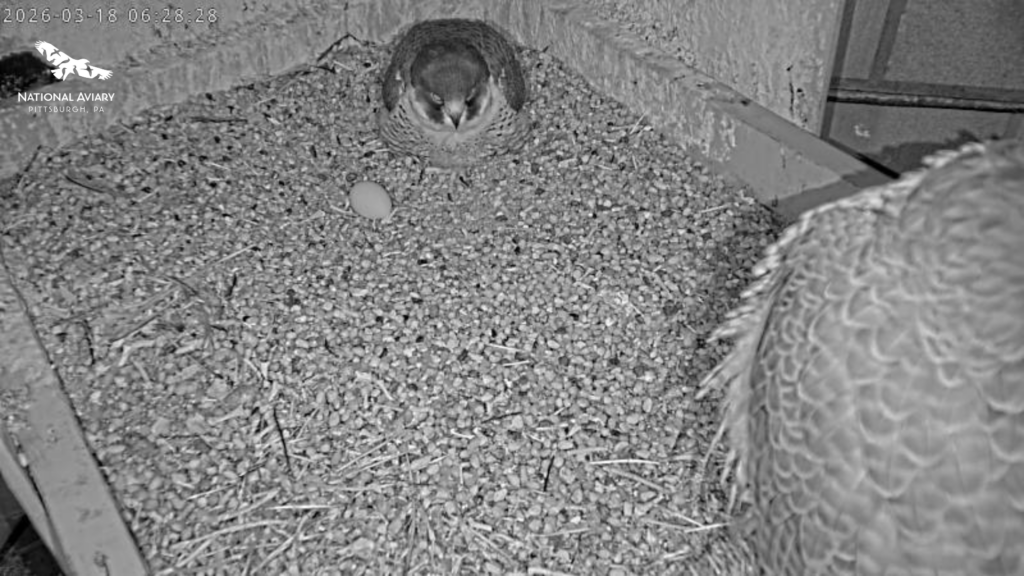
Until Carla and Ecco begin round-the-clock incubation, it’s perfectly safe to leave the eggs to be left uncovered, as Peregrine Falcon eggs can endure inconsistent climate changes brought by the spring season. Tune in to what will hopefully be another exciting breeding season, sponsored by Ninja Transfers.
It’s important to remember that the Peregrine FalconCam gives us a view into the wild world of birds, and while it’s not our role to intervene, we can learn a lot by studying these behaviors.
February 26: ICYMI: A record six Peregrine Falcons were counted in Allegheny County during the recent Audubon Christmas Bird Count – the nation’s longest-running citizen science project. The data collected helps inform ornithologists on bird populations and plays a key role in guiding necessary conservation actions – like those taken to protect Peregrine Falcons from extinction.
By the early 1960s, U.S. Peregrine Falcon populations had declined so sharply, primarily due to the usage of DDT (a harmful pesticide that negatively affects reproduction rates in birds), that they were no longer nesting in the state of Pennsylvania. Because of the banning of DDT in 1972, followed by intensive conservation efforts spearheaded by The Peregrine Fund at Cornell University, the species has rebounded very well, prompting its removal from the federal Endangered Species List in 1999 and from Pennsylvania’s Endangered Species list in 2021.
Will Carla and Ecco continue to contribute to the growing eastern Peregrine Falcon population? Having laid her first egg of the breeding season on March 16 last year, Carla should lay an egg within the next few weeks, so be sure to tune in often for a chance to witness the start of their 2026 nesting season!
It’s important to remember that the National Aviary Peregrine FalconCam gives us a view into the wild world of birds, and while it’s not our role to intervene, we can learn a lot from studying these behaviors.
February 9: As you continue to tune into the National Aviary Peregrine FalconCam, you may be wrapped in a blanket or wearing a cozy crewneck to stay warm…but how do Carla and Ecco stay warm in frigid temperatures? Birds, like Carla and Ecco, need two things to maintain their core body temperature: minimizing heat loss and maximizing energy intake.
Minimizing Heat Loss
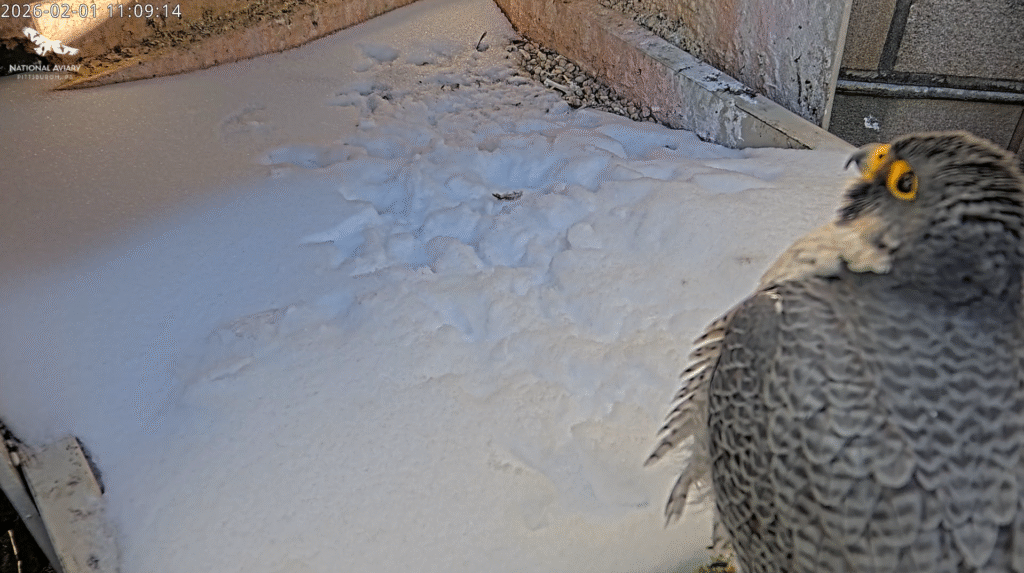
National Aviary Ornithologist Bob Mulivhill likens a bird’s feathers to the layers of clothing humans put on to stay warm. “Feathers are a bird’s barrier between themselves and the environment, and like the outer layers we put on, they can trap a layer of warm air next to the skin [and hold it there]. We tend to adjust our outer clothing layer according to the temperature, so that we remain comfortable. Birds, however, can micro-adjust their ‘clothing’ (aka feathers) by tailoring the exact amount of heat trapped underneath their feathers.”
So, what does that mean? In very cold weather, birds will fully fluff their feathers (as viewers may have seen on the live stream) creating the biggest pocket to trap the warm layer of air next to their body.
Maximizing Energy Intake
As with building a campfire, the more logs on the pile, the greater the output of energy. The same concept can be applied to birds. In cold temperatures, wildlife will increase their food consumption. They will also take advantage of microclimates (a small area within a large climate) that offer different atmospheric conditions. For example, Carla and Ecco may roost overnight in the more sheltered spots to avoid direct wind and take advantage of any sunny patches during the day.
So, with Punxsutawney Phil predicting six more weeks of winter, Carla and Ecco may have to continue minimizing heat loss and maximizing energy intake for just a bit longer!
It’s important to remember that the National Aviary Peregrine FalconCam gives us a view into the wild world of birds, and while it’s not our role to intervene, we can learn a lot from studying these behaviors.
February 1: The National Aviary Peregrine FalconCam is back for another swoop-tacular season!
ICYMI: 2025 was another thrilling year for Peregrine mates Carla and Ecco, who have occupied the nest box at the Pittsburgh University’s Cathedral of Learning as a bonded pair for the third FalconCam season in a row.
Last year, falcon Mom and Dad successfully hatched several chicks, with the first two making their arrivals on April 24 – just in time for National Take Your Kid to Work Day, followed by the third on April 27.
The three hatchlings carefully grew under the watchful eyes of Mom, Dad, and dedicated livestream viewers could often see them napping on camera, (just like with infants, rest is vital for their development!). As part of an ongoing statewide effort to monitor the Peregrine Falcon population, the Pennsylvania Game Commission (PGC) biologist Patricia Barber who, with assistance from the Aviary’s friend and supporter Kate St. John, completed health exams before banding the chicks in late May. The health exams included noting their weight and measurements of leg thickness, which led Barber to suspect at the time of the banding that the two larger juveniles are female, and the smallest male.
The bird banding process involves placing a small, lightweight band marked with an identifying number on a bird’s leg. Using the numbers on the bands, scientists can study the behaviors of Peregrine Falcons while also determining the status of their populations. Dedicated Peregrine FalconCam fans will recall that the species was formerly Endangered in Pennsylvania until recently, due to the use of agricultural pesticide DDT. Being able to access the data collected from bird banding is critical for the species’ continued survival.
Representatives of the PGC and the National Aviary alike remain enthusiastic about what last year’s additional banding meant, not only for the future of the Peregrine Falcon but avian conservation in its entirety: “The Peregrine Falcon was removed from our state’s threatened and endangered species list in 2021 after more than 40 years,” said PGC Endangered Bird Biologist Patricia Barber, “and yet we continue banding at the Cathedral of Learning nest for the immense educational value it provides. This is a species that Oakland residents can see soar overhead; a species that has also grown a large digital following thanks to the National Aviary’s FalconCam. The more information we can track and share, the more invested in the well-being of all birds these audiences become.”
“Last year’s banding was another crucial step towards conserving the future of the Peregrine Falcon in the wild,” says National Aviary Ornithologist Robert Mulvihill. “We [at the National Aviary] were greatly moved by the opportunity to orchestrate the banding of THREE additional Peregrine Falcon chicks. Banding is so vital to the continued plight of the species, and the data we received from this banding allows us to continue to track the birds’ movements, survival rate, mating history, and other aspects of biology that make our job that much easier. After two successful seasons, I am personally so excited to see what the next year of the National Aviary Peregrine FalconCam brings!”
A few weeks after the banding, the chicks officially fledged the nest, though they continued to stay nearby, like in June, where one of the females (unofficially going by the moniker of Yellow as she is recognizable through her yellow band) was last spotted on camera briefly perched on the nest box. Since then, after building the flying and hunting skills necessary for independent survival, we believe the three have taken off to start their next chapter. Thanks to their genders, we have an idea of where they may each land; their banding will tell us where they ultimately end up. Peregrine females usually fly father distances than males—and may even “set up shop” as far away as Ontario, while males tend to stick closer to the nest region. Only time (and eventually more data) will tell!
Stay tuned as we hopefully gear up for new, exciting developments and adorable hatchlings from Carla and Ecco in 2026!
-
The History of Peregrines at Pitt
For insights into the happenings viewed on the National Aviary Peregrine FalconCam in recent years, click here.
-
More About Peregrine Falcons
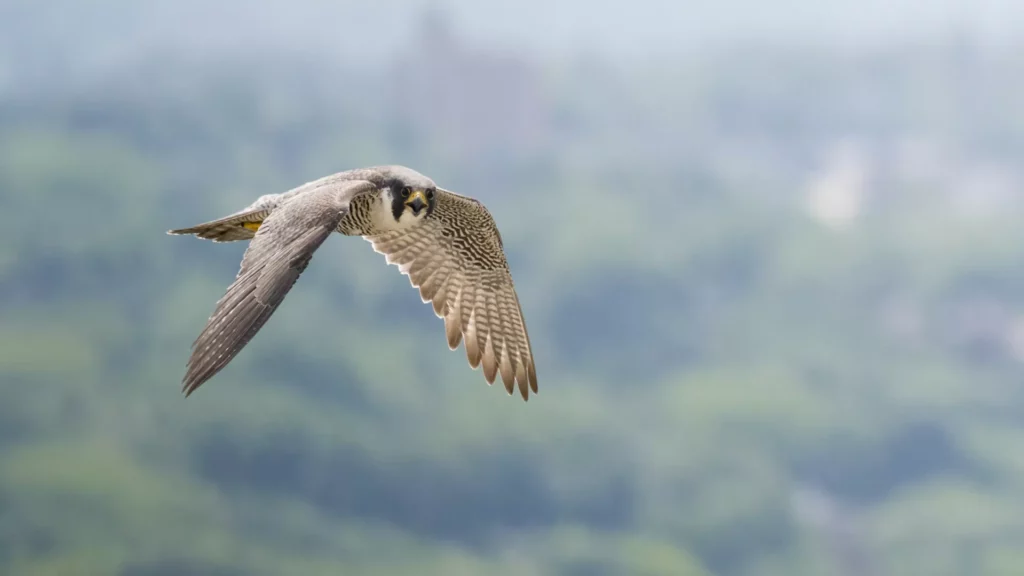
Peregrine Falcons are the world’s fastest animal, capable of diving at speeds of over 200 miles per hour! These fierce birds of prey grow quickly, too. Peregrine Falcons nest on cliffs or ledges of tall buildings where they lay a group of up to four called a “clutch”, in a bowl-shaped depression in gravel.
The female Peregrine incubates the eggs for about a month, sitting on them to keep them warm. During this time, the male brings food for the female – ensuring that she stays with the eggs to keep them warm. When the chicks hatch, they are small, nearly featherless, and very dependent on their parents. But, they mature very quickly, and within a week of hatching they nearly double their size! Within a month, they go from having soft, downy white feathers to dark brown feathers, or plumage. By around 5 weeks old, they are ready to fledge the nest! Peregrine Falcons stay with their parents through the beginning of summer, learning to hunt and navigate their world.
-
Falcon + Flighted Friend Encounter

An Animal Encounter participant holding a Lanner Falcon
Daily* at 2 pm
Members: $66.60 per person
Non-Members: $74 per person
Includes General Admission
Ages 12+
*Available May 23 – September 7All of the same joy that comes during our traditional Falcon Encounter…and then some! For the first time EVER, get DOUBLE the feathered fun during a brand-new Falcon + Flighted Friend Encounter in our Helen M. Schmidt FliteZone™ Theater.
Proceeds from Animal Encounters support our work to save birds and protect their habitats.
-
Plan a Trip to the Aviary
Did You Know…
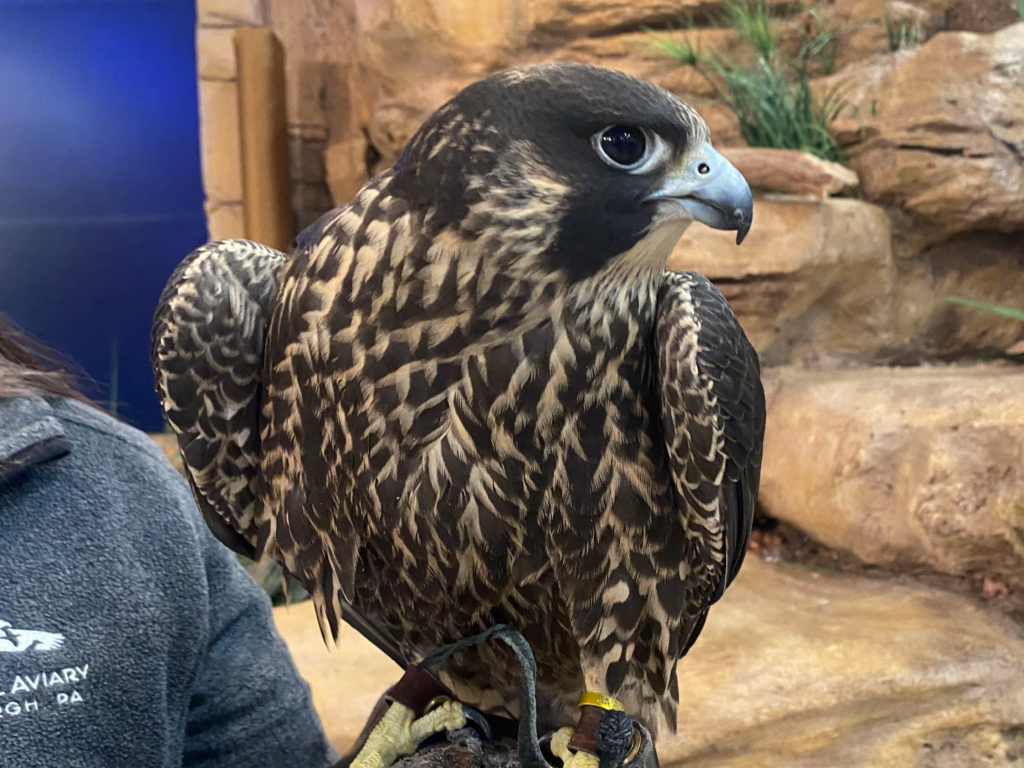
…the National Aviary is home to a Peregrine Falcon?! Want to learn how you can get even closer to him and uncover the adaptations that make his species oh-so talon-ted? Call 412-258-9439, email [email protected], or fill out our Adult Group Inquiry Form!
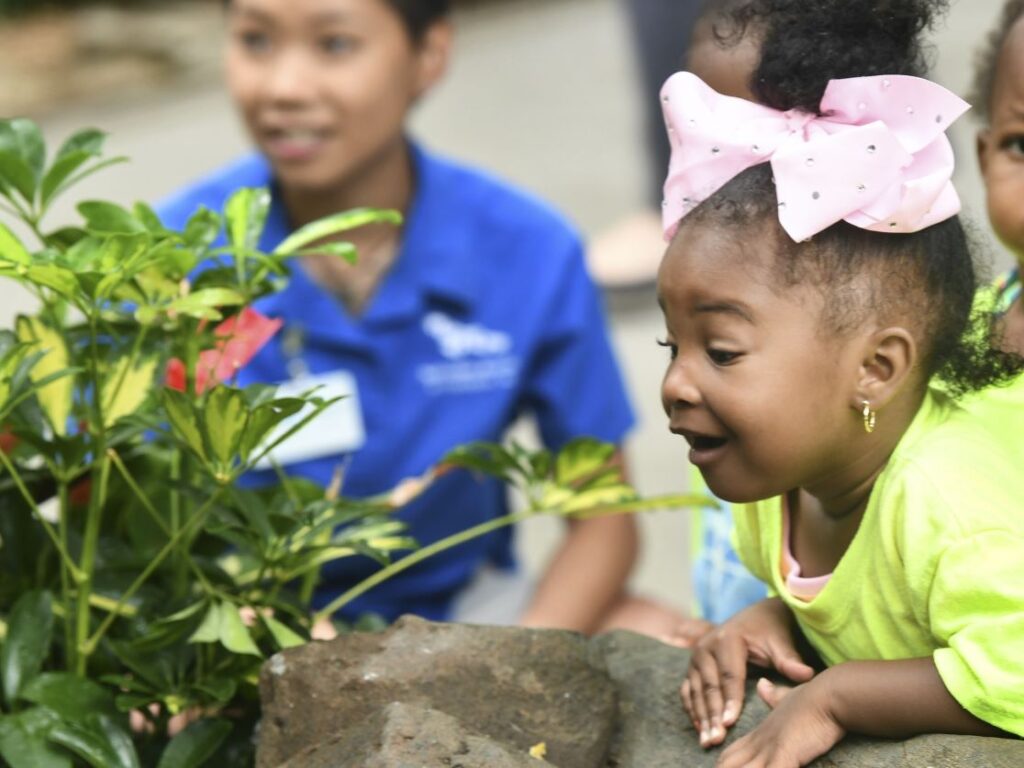
Interested in planning a Field Trip to the National Aviary, or having an Aviary expert visit your school? Learn more here!
For more news about all of Pittsburgh’s Peregrine Falcons, visit Outside My Window, Kate St. John’s Bird Blog. Thank you, Kate, for your continued support of the National Aviary Peregrine FalconCam.
The National Aviary would also like to thank Rush Order Tees and Ninja Transfers for their sponsorship of the National Aviary Peregrine FalconCam, as well as the University of Pittsburgh for their continued commitment to the conservation of Peregrine Falcons.