Field Season 2025
Field season 2025 began in January and was in full swing February through June. Based on auditory encounters in previous years, Dr. Latta and the team shifted to less searching on foot and more “sits and listens”. Camouflaged and still, deep within prime focal areas, we relied on our ears to detect vocalizations or knocks, in particular hoping for the heavy repetitive strikes of cavity excavation, which Tanner described as “surprisingly loud”.
Auditory encounters were strangely low in abundance this field season. However, 2025 did not disappoint. In mid-February, Dr. Latta came upon something he had never seen: a partially live hickory tree freshly and extensively scaled.
Several years ago, Mark Michaels gave us a walking tutorial on the topic of scaling. One notable takeaway was “Pileated = patchy, Ivorybill = extensive”. “Extensive” was difficult to imagine except for what we see in some of the old photographs, and a picture of a tree Mark had encountered over ten years ago. The tree that Dr. Latta encountered was nearly a clean slate, fresh enough that the wood was still a bit moist, the remaining bark still very tightly adhered, and leaf buds still present in the crown. The bark removal was impressive, and the remaining bark was incredibly tightly adhered. Extensive now seemed like an understatement. None of us had seen anything like it.
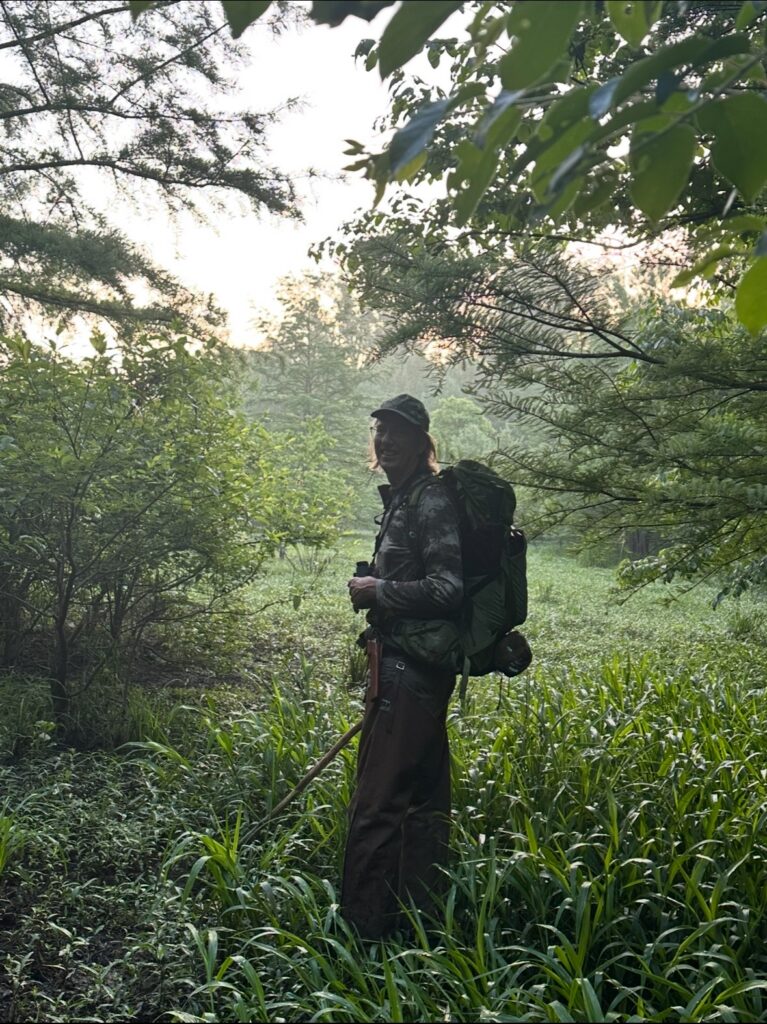
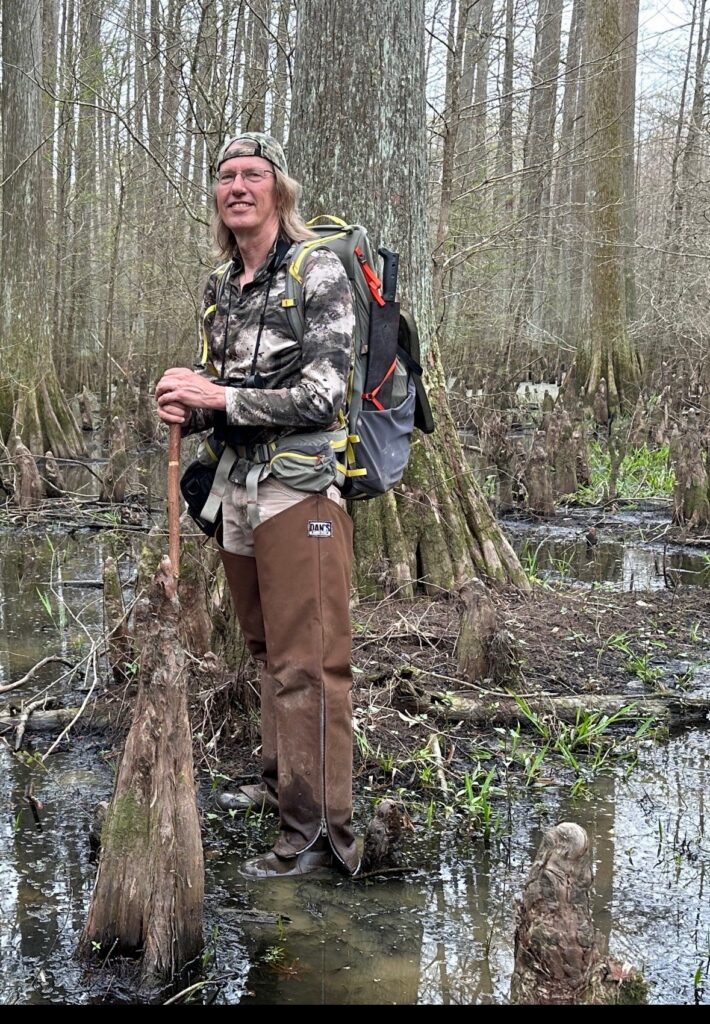
We installed cameras on several aspects of the tree, but were rewarded with only the occasional Pileated Woodpecker, which would land on the bark-bordered edge of the heavily scaled area, poke around for a few seconds seemingly unproductively, then leave.
As the field season progressed into March, we encountered more scaled hickories, all freshly and extensively scaled with tightly adhered remaining bark. On the trees that we were able to get a knife under to pry off a small piece of the remaining bark, we found cerambycid beetle grubs. Cerambycid grubs are known to be a part of the Ivorybill’s diet, particularly when they are feeding nestlings, and nestlings are said to refuse larger grubs. We could not help but notice the timing of this feeding sign.
By April, Dr. John Trochet had encountered another, similarly scaled tree. As was the case with the first tree, we placed motion detection cameras on several aspects, but only captured photos of brief Pileated Woodpecker visits. The Pileateds were observed testing a few areas on the scaled area and bark border, but left within a minute or so, without removing any bark.
Recognizing the potential importance of these trees, our team placed long-term motion detect cameras on other live, but declining, hickories adjacent to those trees already found with the extensive scaling. Our hope was to get ahead of the next scaling event and to catch an Ivorybill “in action”.
In early June, our team flushed a bird of interest from a low point on a hickory. The bird was not visualized, other than through its movement as it flushed and flew rapidly away. Upon arriving at the tree from which it had flushed, we encountered large bark chips and noticed a lateral strike mark that many consider indicative of Ivory-billed Woodpecker foraging attempts. Cerambycids were found beneath the bark of that tree as well. We placed long-term motion-detect cameras on it, as well as on other nearby hickories.
While bill strikes are not likely to yield much DNA, we know that a woodpecker’s sticky tongue would potentially leave DNA behind as it probes the grub holes. We have shown this with samples collected from Pileated Woodpecker foraging sites. So, each of the extensively scaled trees we encountered had potentially hundreds of exposed grub holes throughout the scaled areas.
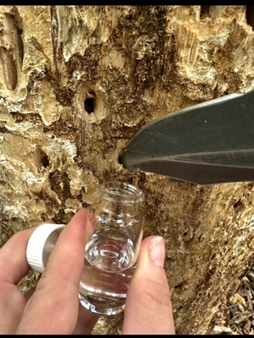
We attempted to collect this environmental DNA (eDNA) using two methods. First, we inserted sterile swabs moistened with ethyl alcohol into the vacant grub holes and twirled them around. The swab tips were then broken off into an ethanol solution for later analysis. Second, we scraped particulate material with very light shavings from around the entrance of each grub hole. This material was also placed in ethanol vials for analysis. Those samples are now being analyzed in the lab.
Our team had two major sightings in the field season of 2025. Both occurred in April on consecutive days and in nearby locations. The first was by Dr. John Trochet, an experienced, world-class birder and highly qualified team member who devotes several weeks of his time each year to this search. The second was by wildlife biologist Peggy Shrum, who logs the most search hours in these bottomland forests year after year. Despite concentrated subsequent efforts in the area of these sightings, we turned up nothing further.
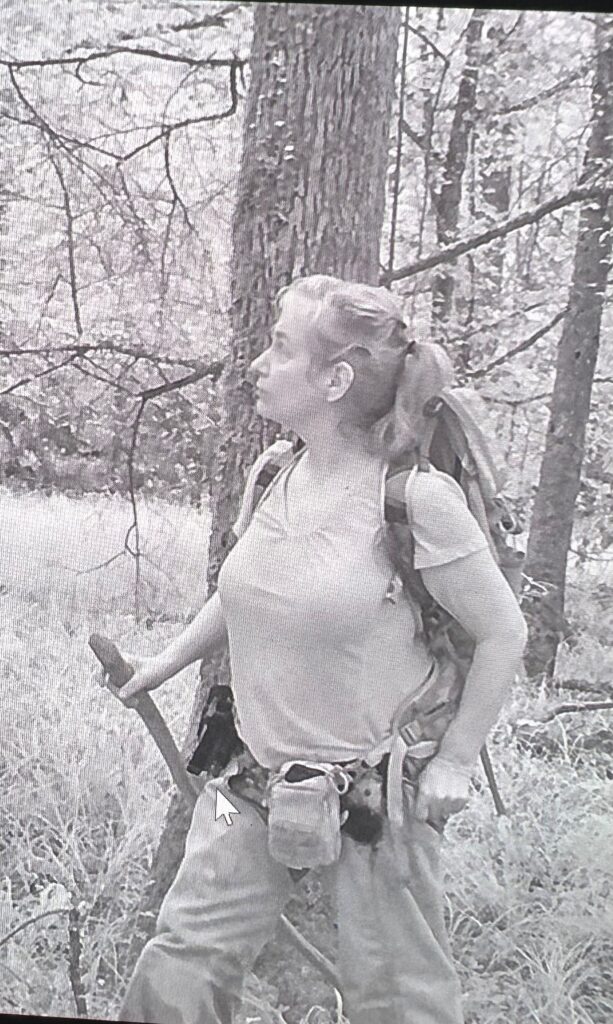
We maintained a full-time yet subtle presence in our study site throughout the field season. Summer slows us down a bit, as the temperatures can become dangerously hot, the vines and vegetation unruly, and the snakes active! We devoted one week per month through summer to check and maintain our cameras, and to do “sits and listens” in the early morning hours. As fall approaches and the temperatures moderate, we will extend our hours and look forward to the next season of searching.
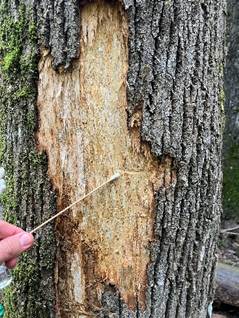
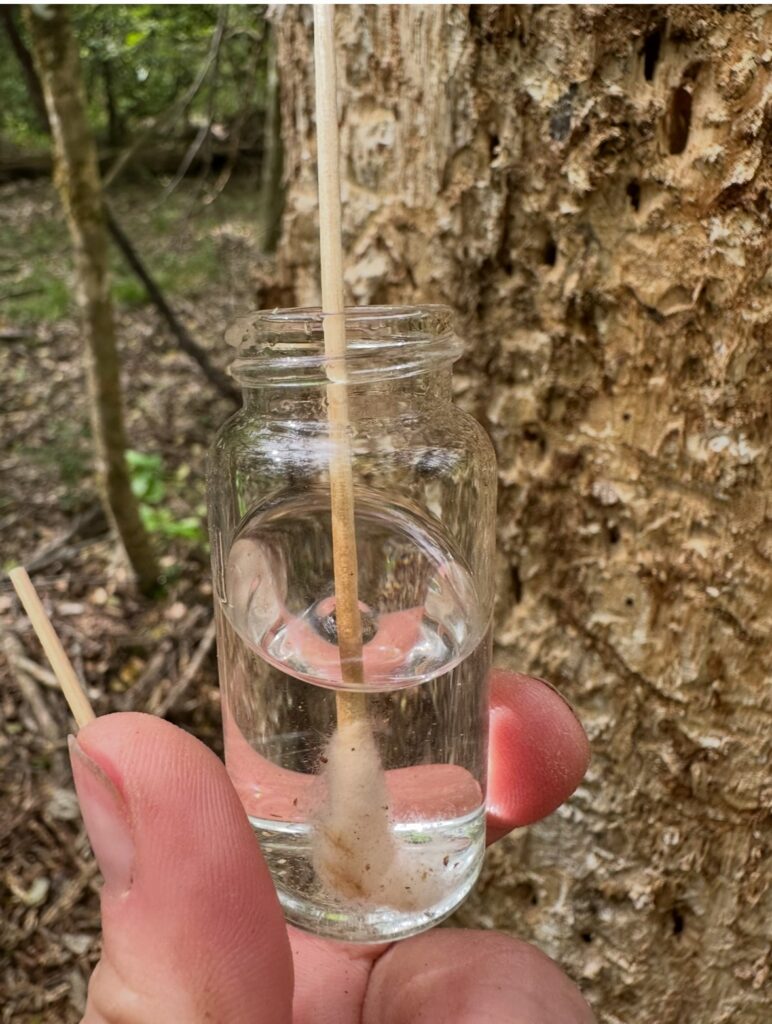
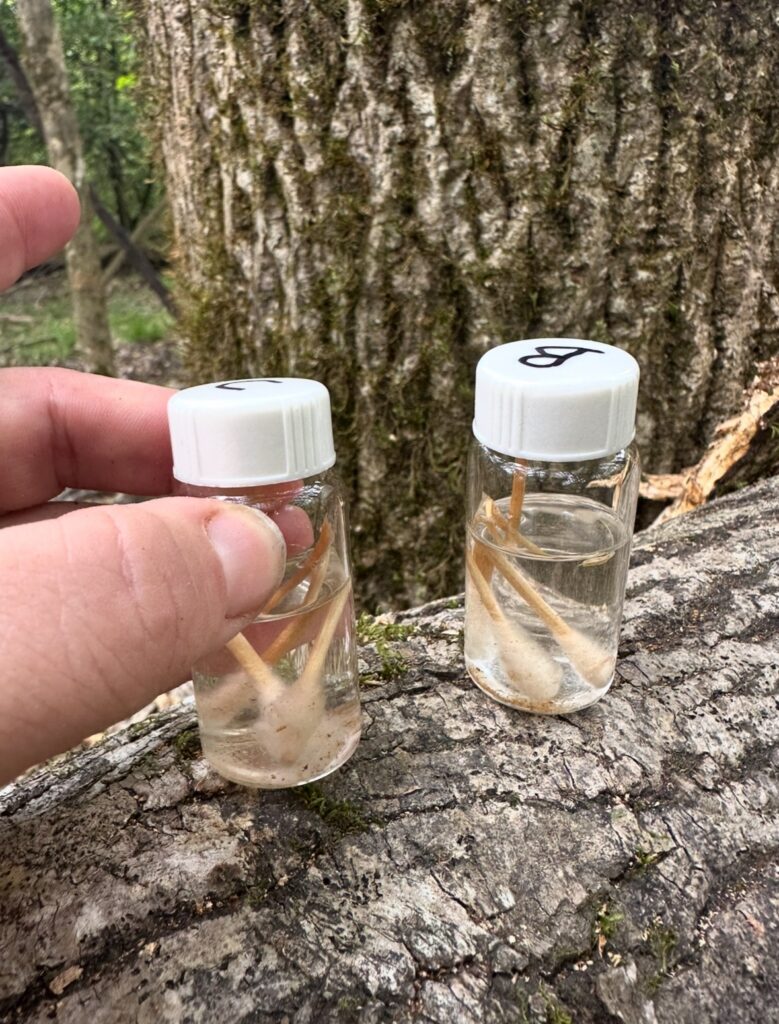
Collecting eDNA from an apparent lateral strike mark on a live hickory tree with very tightly held bark (left)
Peer-Reviewed Paper about the Ivory-billed Woodpecker
Encouraged by the recent announcement of the U.S. Fish and Wildlife Service’s decision to postpone the delisting of the Ivory-billed Woodpecker (Campephilus principalis), Project Principalis, a partnership of the National Aviary and independent researchers, continues to research the existence of the iconic species.
Prior to the extension, the research team released new evidence supporting the persistence of Ivory-billed Woodpeckers in Louisiana. The research appears in the open-access peer-reviewed journal, Ecology and Evolution. The paper builds on an existing body of work and presents personal accounts, audio recordings, trail camera images, and drone footage depicting multiple birds, supplemented with new videos.
Read more about the research here.
The National Aviary is a leader in avian conservation, animal care, and education. You can support our work, including initiatives like Project Principalis:
Donate TodayPresented Video Evidence to U.S. Fish and Wildlife Service
The findings, which suggest the continuing survival of the iconic birds in Louisiana, include a pre-print paper documenting multiple lines of evidence published earlier this year on the pre-print server bioRxiv, and new video evidence showing what appears to be an Ivory-billed Woodpecker. The submissions are available for the public to access on the United States Fish and Wildlife Service website. The video can be viewed here.
View the full presentation to U.S. Fish and Wildlife Service, including supplemental materials and video, and find additional supporting comments here. Read the press release announcing the new findings here.